Team 10: Citizens’ Review Board finds no evidence of strip search – 10News.com KGTV ABC10 San Diego

http://www.10news.com/news/team-10-citizens-review-board-finds-no-evidence-of-strip-search-061615

“SAN DIEGO – Team 10 has obtained new information about the incident involving two San Diego Police officers and the man who claims they did an illegal anal cavity search for drugs.

The findings of San Diego’s Citizens’ Review Board show they agree with Internal Affairs investigators that Kenneth Simmons was not subjected to a cavity search. The board also found the use of force on Simmons was justified.

Simmons was riding his bicycle in Memorial Park in May of 2014 when officers claimed they tried to stop him for not having a light after dark. Officers say Simmons tried to get away, and when they caught up with him he resisted arrest. Simmons had two knives, and police body cam video shows him on the ground struggling with officers who told him to “stop resisting.”

Officers say they found rock cocaine in a baggie in Simmons right pants pocket. Simmons claims he was violated in the most personal way, and that the drugs were in his rectum.”

Posted in Uncategorized | Leave a comment

OverCriminalized #1 • BRAVE NEW FILMS” on YouTube

image


Watch “Why Are We Using Prisons to Treat Mental Illness? • OverCriminalized #1 • BRAVE NEW FILMS” on YouTube

Posted in Uncategorized | Leave a comment

Man to Sue Sheriff’s Dept. Over Arrest as Friend Died | NBC 7 San Diego

http://www.nbcsandiego.com/news/local/Man-Arrested-as-Friend-Died-to-Sue-Sheriffs-Dept–307757311.html

“A man who watched his friend die in a motorcycle crash and was arrested for interfering with rescue efforts now plans to sue the San Diego County Sheriff’s Department.
After the department rejected his claim, Jon Regenhardt told NBC 7 Tuesday he will file a lawsuit against the agency through his attorney, Steve Estey, hoping to get the deputy who arrested him fired.
His reasons date back to Oct. 5, 2014, when his best friend, 25-year-old Navid Zamani, was fatally wounded in a motorcycle crash on State Route 94 in Dulzura when he collided with a pickup truck.”
“I lost my heart. I lost my soul. I lost my best friend,” said Regenhardt.

Posted in Uncategorized | Leave a comment

Watch “Scars & Stripes 4 Mile March – July 4th. 2015 – Strange Fruit” on YouTube

Posted in Uncategorized | Leave a comment

Via CURB; JUNE 26 Statewide Mobilization for #NoMoreJails! Let’s #PullthePlug on jail expansion. RSVP: http://t.co/l4Q6ULYKVj http://t.co/GbA6I2r7W1

image

The statewide jail fight crew is gearing up for the mobilization to BSCC Bidders’ Conference in Sacramento on June 26th. The first salsa blast went out yesterday with the snazzy (gif) flier that Critical Resistance-LA members designed.

Please circulate the flier and facebook page! Spread the word!

Here are the relevant links:

Join and share the event page on FB: http://on.fb.me/1Ii0cha

Retweet: http://bit.ly/1LfNyVS

Donation page to support travel: bit.ly/1L9OaJx

Salsa blast: http://bit.ly/1IPq6M1

ALTERNATIVE INVESTMENTS TO IMPRISONMENT

Flier: http://bit.ly/1GJJ4nF

(adapted from the No New San Francisco Jail Coalition’s Jail Fight Platform http://www.nonewsfjail.wordpress.com
and Critical Resistance’s “Alternative Investments to Imprisonment” http://www.criticalresistance.org)

NO NEW JAILS!
Californian’s health and safety will not be improved with jail expansion.

California county jails are inherently violent, poorly run, and wastes of taxpayer money. The public funds that are now used to police, convict and incarcerate people should be going to provide housing, education, health care & employment. Safe and healthy communities depend on mental health services, youth centers, supportive and affordable housing, and real opportunities in their communities; not cages.

Californians want, deserve, and demand to live in a state that prioritizes the health, wellbeing, cultural and political life of all of California residents. Currently, many California residents are facing hard times. It is difficult for many people—particularly in communities of color–to find meaningful work, affordable housing, and access to good education and sustainable healthcare. Decision-makers with the power to change these conditions, however, are not focusing on our communities’ needs. Instead, many political leaders are prioritizing spending more of our tax dollars on building more jails, hiring more police, and subsidizing more high-end condos and luxury apartments. We do not need more jails in California counties. We need the basic resources and opportunities that make our communities healthier and
whole.

COMMUNITY BASED SOLUTIONS AND ALTERNATIVES TO INCARCERATION
Academic and community-based research, repeatedly finds that community-created and community-
focused solutions to harm and violence have exponentially better outcomes.

Unlike jails, local solutions
and community resources are much more likely to keep families intact, assist loved ones to overcome
the hardships of addiction, reduce the likelihood of repeated harm, increase community stability.

Communities prosper when they are healthy, stable, and people have the tools and resources necessary
to build strong relationships.

WHAT WE WANT, WHAT WE NEED
AB 109 funds would be better used to:
Support violence prevention practices that motivate and empowers young leaders and neighborhoods to take a stake and central role in building up their communities.

We need to use and continue to develop responses to harm that help people flourish and learn without punishment and separation from their families and communities (i.e. without imprisonment and policing).

Prioritize mental health and treatment in all of California’s counties.

Fund treatment programs that prevent people from doing time and also helps those coming home transition more successfully back into their communities.

Provide health care for all Californians and to connect people coming home from jail to available healthcare services and insurance.

Posted in Uncategorized | Leave a comment

2013; San Diego County to review protocols for transgender detainees

http://m.dailykos.com/story/2013/01/05/1176306/-San-Diego-County-to-review-protocols-for-transgender-detainees
“Five years ago the San Diego County Sheriff, Bill Kolender at that time, issued a two-page “training bulletin” as guidelines for handling transgender inmates at local jails.  The document provided Webster’s dictionary definition of transgender before adding the following:

It is believed that transgender individuals have always existed in our societies.  These individuals are often viewed by their friends and families as the sex they are representing and their expectation is that society views them in the same manner.
The document was issued because of the death of a 35 year-old transwoman, Vanessa Facen.  She died in custody four days after a fight with deputies in the San Diego Central jail.  Even though she lived as a woman and had breasts, she had been housed with men because she still had male genitalia.  When the document was issued, the Sheriff’s Department also agreed to institute sensitivity training…but no formal policy was developed.
In 2011 several transgender inmates housed in a segregated unit at the George F. Bailey Detention Facility at Otay Mesa filed complaints with the Citizen’s Law Enforcement Review Board (CLERB) against 11 deputies and medical staff. 

The transgender inmates claimed that guards made crude, sexual remarks to them, such as: “I’m going to miss watching you two shower,” “Look, it’s the ugliest girls in George Bailey,” “I’ve got a delivery of summer sausage. Can I park it in your rear?” and “Oh God, fucking faggots.  We’re surrounded by six, nasty, disgusting faggots.”  One guard was accused of trading his cell phone number to an inmate in exchange for a look at the inmate’s breasts.  The inmates also said they were denied access to religious and education programs and, in one case, AIDS medication.
CLERB couldn’t come to a decision on the complaints within the year allotted by state law, so the complaints were dismissed.  Although the federal Prison Rape Elimination Act requires local detention authorities to report publicly the number of sexual-harassment complaints, the Sheriff’s Department reported no allegations for 2011 on the required forms.
In a meeting with San Diego CIty Council President Todd Gloria and other gay advocates Sheriff Bill Gore committed to forming an LGBT advisory board.  Gore also agreed to grant unsupervised interviews with transgender detainees.

The inmates admitted that the lead compainant (since transferred to the state prison at Tehachapi) had a tendency to exaggerate.  Former chair of the city’s Human Relations Commission Nicole Murray-Ramirez reported that the inmates interviewed said that 95% of the guards treated them respectfully, even using female pronouns to address them.

But the other 5% can sure spoil a person’s day.  And why should we celebrate being addressed with correct pronouns?  That’s not cookie-bearing behavior.  That should be the default.

But many of the complaints were reaffirmed, including lack of access to religious services and private substance-abuse counseling, Murray-Ramirez says.  One inmate reiterated a complaint that HIV medication was not provided for at least four days.
All transgender inmates are held in protective custody, which means they’re housed near the unit reserved for sexually violent predators.  Several lamented the impression of some sort of similarity between transgender people and child molesters.

The 2007 bulletin was redistributed in 2009 and includes issues such as access to hormone therapy and bras and the exercise of sensitivity in regards gender, especially when it comes to strip searches.  The penal code requires that strip searches on inmates with male genitalia be performed by male guards, regardless of gender.
For these individuals the process can be frightening.  You should be able to understand that the level of stress and fear will be even higher for an individual who has been living as a woman for the past ten years and now finds they are being booked into a male facility.  You are encouraged to take a few moments to explain the process and answer questions to relieve some of their anxiety.
Little things go a long way to make an environment less hostile than it needs to be.
–Todd Gloria

As usual there is no provision made for or mention of female-to-male transgender people.”

Posted in Uncategorized | Leave a comment

The Real History of Section 8 Shows the Ignorance of People Who Use It as a Racial Slur | Alternet

http://www.alternet.org/civil-liberties/real-history-section-8-shows-ignorance-people-who-use-it-racial-slur?akid=13215.321794.ZFcXRQ&rd=1&src=newsletter1037862&t=13
” The cheap housing was built for white workers during the Depression.
By Terrell Jermaine Starr / AlterNet
June 15, 2015

When Tatiana Rhodes, a 19-year-old black woman who hosted a swimming party in a mostly-white neighborhood in McKinney, Tex., was told to go back to “Go back to your Section 8 home,” she knew it was a racial slur. But Section 8 history tells us that public housing was really designed for working white people, according to the Washington Post.

By now, we all know about what happened at that party on June 5: AlterNet previously reported that a local cop was seen in a cell phone video running around wilding and randomly brandishing what appears to be his department-issued flashlight at balck kids in the neighborhood after responding to a 911 call about a fight at the pool. That same cop, ex-Cpl. Eric Casebolt, pulled 15-year-old Dajerria Becton down to the ground by her hair and pulled his gun on boys who ran over in obvious concern for her safety. Casebolt has since resigned his position.

Before the cops came, some of the white people at the pool yelled the Section 8 slur at the black kids. Here’s what those ignorant white folks obviously do not know. Public housing was created in 1937, as part of the New Deal. It was actually designed to revive the housing industry, not provide shelter for the poor. Housing construction collapsed during the Great Depression and major housing shortages followed. To help revive the industry, the federal government paid for the construction of hundreds of thousands of new homes. Lots of those homes were built on land that had previously been slums.

These homes were built for working-class white families, however. If any of them were built for black people, it was segregated. In large urban cities like Chicago and Detroit, public housing “became a black program,” the Economic Policy Institute’s Richard Rothstein told The Post, “because the Federal Housing Administration created a different program for whites, which was a single-family suburban program.”

The Post breaks down the racism in public housing that allowed poor whites to move to better homes:

The Federal Housing Administration financed the construction of new single-family homes in suburban developments (and government money plotted and paved the roads to get there). The FHA and the Veteran’s Administration also guaranteed cheap mortgages for the families who moved there, making this new kind of owner-occupied housing often just as affordable as rents had been in public housing projects in the city. Like many of those original projects, though, the new homes were explicitly unavailable to blacks. The FHA required developers to use restrictive covenants barring blacks, and it denied black families the mortgages that allowed working-class whites to leave public housing.

As the white “barely poor” moved out — and as the strict criteria for who could live in public housing faded — the median incomes of the families there began to fall. In 1950, the median household in public housing earned about 57 percent of the national median income. That number fell to 41 percent by 1960, then 29 percent by 1970. By the 1990s, the median family in public housing made only about 17 percent what the median family in America made.

Relatively speaking, that means public-housing residents by the 1990s were about three times as poor as they had been in the 1950s.

Most people in public housing today are not even black; around 44 percent of black people receive public housing assistance. A lot of the problems we see in public housing today stem from flaws in the program that date back to 1937. Rents were supposed to pay for property upkeep but housing authorities never had enough money to pay for the buildings. The cheap materials used in the construction mean constant structural issues. Large public housing structures began to be demolished during the 1990s, raising fears (basically among white people) that former Section 8 residents using federal vouchers with private landlords in better neighborhoods would increase crime.

There is no evidence of this, but the fear persists.

There is much more to the history of public housing (which you canread about in The Post), but the main takeaway from the article is that Section 8 housing was originally designed for white people trying to survive and come  out of one of the most economically depressed times in American history, but, somewhere along the way, it became associated with black people. And now it has become another slur against them.”

Posted in Uncategorized | Leave a comment

#Justice4RobertBranch; #FireDetectivePaulWard

Via Allison Ash May 13, 2015 ABC 10

Team 10: Detective’s chokehold on security guard caught on video

http://www.10news.com/news/investigations/team-10-detectives-chokehold-on-security-guard-caught-on-video#Witness%3A%20Detective%20never%20showed%20his%20badge

SAN DIEGO – Cellphone video obtained by Team 10 appears to show a San Diego County sheriff’s detective placing a security guard in a chokehold — an incident that has sparked a sheriff’s department internal investigation.

On May 5, Robert Branch was driving to work on Interstate 8 when he passed a Ford Fusion in front of him. After he passed the car, Branch said the Fusion’s driver tried to force him off the road.

“I’m in the dirt. We’re literally side by side, so now I start picking up speed so I can just back on the freeway,” Branch told Team 10.

Branch drove away from the Fusion and didn’t see the car again until he exited at College Avenue and stopped on a side street.

According to Branch, the driver parked behind him and got out of the car. At that point, Branch said he got suspicious and turned on his cellphone to start recording.

In the video, Branch is heard saying: “I’m in La Mesa right now. You see this officer right now. Right now, he does not have his lights on.”

Branch said, “I don’t see a gun, I don’t see a badge, I don’t see anything, no handcuffs. He pulls out his wallet saying ‘San Diego sheriff’s department.'”

The detective demands to see his license and registration and threatens to detain him, according to Branch.

As Branch’s cellphone continues to record, the plainclothes detective — identified as Paul Ward of the department’s Child Abuse Unit — comes up behind him and puts his arm around Branch’s neck in a chokehold maneuver.

Branch says in the video: “You cannot touch me, you can’t touch me. Sir, can you call police? You see this? You cannot touch me …”

In the video, Branch says “I love you mom” several times because, as he told Team 10, he thought he might die.

The situation escalated, and Branch said he passed out momentarily, causing him to drop the phone. It landed camera-side down on the pavement, but it continued to record.

When he came to, Branch said he started “defending myself, pushing, and I’m saying some words because I’m outraged. I’m mad because you shouldn’t do that.”

Branch was later arrested for resisting arrest, obstructing justice and reckless driving, but his attorney told Team 10 that Ward did not properly identify himself and used unnecessary force on his client.

Pablo Martinez, who alleges he witnessed the incident from just feet away, seems to endorse Branch’s story.

“He (Branch) kept on telling him (Ward), ‘Who are you?’ He kept on asking him, ‘Who are you? Show me something that tells me who you are.’ And the guy just wouldn’t show him. If he was a deputy, that’s news to me.”

Martinez says he watched Ward manhandle Branch, taking him down to the ground twice.

“The kid (Branch) never threw a punch or nothing,” Martinez said. “He just didn’t want him to touch him. And the officer kept on grabbing him.”

“I thought the guy (Ward) was a criminal,” Martinez adds. “If he wasn’t a criminal, then man, that’s abuse.”

“He didn’t make the effort to notify backup or call for a uniformed officer for what would have been nothing more than even an alleged misdemeanor on the road … and you’ve got him resorting to extreme physical violence to hurt Mr. Branch,” said Marc Kohnen, Branch’s attorney.

“I feel like he might do this again to somebody else. After that, I don’t believe he should be on the streets for that. I feel like he should get time for that,” said Branch.

Team 10 contacted the San Diego County District Attorney’s Office regarding the incident, and a spokesperson said the office was reviewing the case to see if criminal charges against either party is warranted.

The San Diego County Sheriff’s Department issued the following report on the incident involving Ward and Branch:

On Monday, May 4, 2015, at about 5:30 p.m., San Diego County Sheriff’s Department Detective Paul Ward was returning to Sheriff’s Administrative Offices after conducting an interview in East County. Detective Ward was on duty at the time. As he was preceding west bound on I-8, in the area of I-125, he observed a vehicle coming up behind him at a high rate of speed. The car swerved to the left, driving onto the dirt center median, fishtailed, and narrowly missed colliding with Detective Ward’s car. The car continued driving erratically, weaving in and out of traffic, west bound on I-8. Detective Ward did not follow the car, but noticed it up ahead, when traffic slowed. He observed this vehicle take the College Avenue exit and he began to follow at that point.

The car ultimately stopped and parked in the driveway of a residence in the 6300 block of Lambda Drive. Detective Ward and the driver of the other car, 25-year-old Robert Branch, exited their respective vehicles. Detective Ward verbally identified himself to Branch as a San Diego Deputy Sheriff and produced his badge and identification card. Branch was wearing a black tactical vest with “Security” on the front with an attached gun holster.

Detective Ward asked Branch for his license and registration, at which time Branch became agitated, uncooperative, and refused to comply with Detective Ward’s request. Branch claimed Detective Ward was not on duty.

Detective Ward attempted to check Branch for weapons, however, Branch physically resisted those attempts. Detective Ward explained to Branch he was being detained, however, Branch refused to comply and began to walk away. At this point, Branch started to record the encounter on his cell phone. As Branch continued to resist, he turned his back to Detective Ward. Detective Ward could not see his hands or if Branch was reaching for a gun or other weapon from the front of his vest. At that point, Detective Ward applied the department-approved carotid-restraint to bring Branch under control. Detective Ward requested a passerby to call the police. Branch passed out for several seconds and then regained consciousness, where he continued to be uncooperative, hostile, and attempted to flee. Detective Ward again placed his arm around Branch in a carotid restraint position, but he did not apply pressure to render Branch unconscious.

Branch continued to struggle when Detective Ward observed Branch holding a canister of pepper spray in his hand. Detective Ward instructed Branch to drop the pepper spray, and at this time, Branch did relinquish it. Eventually, Branch calmed down, complied, and was instructed to sit on the curb and wait for the San Diego Police Department to arrive.

Branch complained of neck pain and to ensure he did not suffer any injury, paramedics were summoned. Branch was transported to Scripps Mercy Hospital for medical evaluation and was subsequently cleared to be booked into jail. Detective Ward was later treated for minor injuries.

Branch was booked into Central Jail for Resisting an Officer (felony) and Reckless Driving (misdemeanor). The case has been referred to the District Attorney’s Office for review and evaluation.

Any time force is used by a Deputy Sheriff, the incident is reviewed to determine if department policy was followed. This encompasses all elements of the situation, to include tactics.

Original Story Man Videotapes Sheriff’s Detective Arresting Him After “Road Rage” Incident

A San Diego man is fighting to get multiple criminal charges dismissed after a confrontation with a plain clothes detective, something his attorney called “road rage by police officer.”

San Diego County Sheriff’s Department officials say one of their detectives was on duty when he witnessed Robert Branch driving erratically and weaving in and out of traffic along I-8 near the 2nd Street exit at about 5:30 p.m. on Monday, May 4.

 Branch, 25, videotaped his arrest and shared it with NBC 7 Thursday, claiming he was put in a chokehold that caused him to pass out.

“I got an arm around my neck and I’m getting choked out, choked out like he’s choking me so bad you can’t hear me breathe,” Branch said. “You can hear it in my voice that I’m trying to get air into my lungs.”

Branch was arrested and charged with felony obstruction of justice as well as reckless driving and resisting arrest. However, his attorney, Marc Kohnen, said those charges are a cover-up for the detective’s behavior.

When his car swerved and drove into the median, Branch claims it was because another car pushed him off the road. He later learned Sheriff’s Detective Paul Ward was behind the wheel of the unmarked car.

Branch said he exited I-8 at College Avenue to investigate something rattling in his trunk when he saw Ward pull up and park behind him.

Ward identified himself as a detective with the San Diego County Sheriff’s Department and asked to see Branch’s driver license and registration.

Branch told NBC 7 the detective showed a badge but no picture identification, wasn’t wearing a gun, handcuffs or a radio.

“I had a bad feeling about him,” Branch said. “I’m going to go ahead and video tape this for my safety.”

Sheriff’s officials say Branch “became agitated, uncooperative, and refused to comply with Detective Ward’s request.”

Branch himself admits he told Ward he would show him his license but not his registration. He also says he asked for a uniformed police officer to come to the scene.

What happened next was captured on Branch’s phone.

In the video, Branch repeatedly says “you cannot touch me” and tells Ward that he did not have lights on.

Then, the detective puts Branch in a chokehold.

Branch’s phone drops and stops recording video.

Sheriff’s officials say Branch was wearing a tactical vest with “security” written on it. When Ward attempted to check Branch for weapons, the young man turned away from the detective.

 “Detective Ward could not see his hands or if Branch was reaching for a gun or other weapon from the front of his vest. At that point, Detective Ward applied the department-approved carotid-restraint to bring Branch under control,” sheriff’s department officials said in a statement.

“I wanted regular police to come. I wanted them to handle the situation the way it should be,” Branch told NBC 7. “I really thought I was going to die.”

Branch admits he considered using the pepper spray he had in the vest.

“I’m thinking if I spray him, he might let me go but I didn’t because it might go into a different situation,” he said.

He said he asked Ward if he knew about the increased tension in cities like Ferguson, Baltimore and other places.

Both Ward and Branch claim they asked a bystander to call for help.

Eventually the San Diego Police were called and arrived to take Branch into custody.

Read the entire statement from the San Diego Sheriff’s Department here.

Kohnen said Det. Ward had nine miles to call for a uniformed patrol.

“Officer Ward had every opportunity to call for backup to diffuse the situation,” Kohnen said. “This would’ve been an entirely different outcome.”

Branch said he’s grateful he thought to record the encounter.

“If I didn’t have that video, I would probably be in jail,” Branch said. “That’s the new thing, everybody needs to start videotaping.

RELATED: Team 10 sources: DOJ looking into San Diego County Sheriff’s Department

Posted in Racial Profiling, SD Sheriff | Tagged , , , , , , | Leave a comment

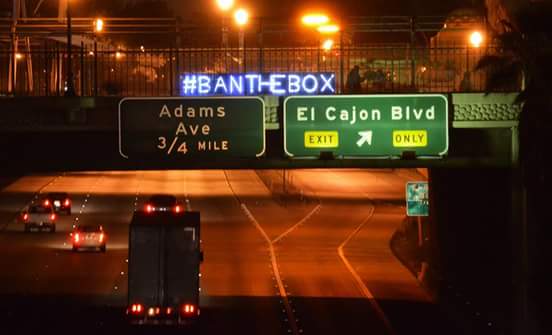
#BANTHEBOX Action by #OLB #UAPTSD

image

#BANTHEBOX Action by #OLB #UAPTSD
The OTHER side of #WORKERSRIGHTS Around 65 million Americans of working age have criminal records. Finding a job isn’t easy for anyone, but it’s especially difficult for them.
Many times #FormerlyIncarceratedIndividuals are barred from filling certain jobs by federal or state laws. But in many instances, employers simply are reluctant to hire people with criminal records and eliminate such applicants from consideration before even reviewing their qualifications.
BAN THE BOX: U.S. CITIES, COUNTIES, AND STATES ADOPT FAIR HIRING POLICIES
by Michelle Natividad Rodriguez
“Nationwide, over 100 cities and counties have adopted what is widely known as “ban the box” so that employers consider a job candidate’s qualifications first, without the stigma of a conviction record. These initiatives provide applicants a fair chance by removing the conviction history question on the job application and delaying the background check inquiry until later in the hiring To support your state and local efforts to enact a fair chance policy, check out NELP’s Fair Chance – Ban the Box Toolkit, which provides a step-by-step guide for advocates on how to launch a “ban the box” campaign. Embedded in the Toolkit is a range of resources to draft a law, to build your network, to support your outreach, and even to develop your media outreach. Here, are just a few of the resources: http://www.nelp.org/publication/the-fair-chance-ban-the-box-toolkit/”

Posted in Uncategorized | Leave a comment

Anger And Grief At Vigil For Kalief Browder

http://m.huffpost.com/us/entry/7569394
“BLACK VOICES
Anger And Grief At Vigil For Kalief Browder
Christopher Mathias New York Reporter, The Huffington Post

NEW YORK — A vigil Thursday evening for Kalief Browder — the young Bronx man who died by suicide this week after spending his teenage years in jail without a trial — started with a prayer.
“We’re here for one reason and one reason only,” Rev. Jackie Lewis told a crowd of about 100 people from the steps the Manhattan Detention Complex. “We’re here to grieve. We’re here to grieve the loss of a particular life, Kalief Browder, who began to die the day he was arrested at 16, and incarcerated and held for 1,000 days without due process.” 
“He began to die every time someone injured him, tortured him, raped him, isolated him,” Lewis continued. “He began to die when his hope died. He began to die when the system failed him.”
Browder was 16 years old in 2010 when he was sent to New York’s notorious Rikers Island jail for allegedly stealing a backpack. Browder always maintained his innocence. He was unable to make bail, and the Bronx district attorney’s office repeatedly delayed his trial. Browder spent three birthdays at the facility. The charges against him were ultimately dismissed.”

Posted in Uncategorized | Leave a comment