n the first half of 2015 police have shot and killed 462 people. 27 percent of the deceased – 124 people – were mentally ill or in emotional distress. Via the Washington Post

In the first half of 2015 police have shot and killed 462 people. According to an investigation by the Washington Post, 27 percent of the deceased – 124 people – were mentally ill or in emotional distress.

While the majority of the individuals were armed, the Post points out that in most cases, they were gunned down by officers who were not responding to reports of any crime.

Frequently the officers were called by neighbors and relatives expressing concern that a mentally ill family member or friend was exhibiting erratic behavior.

Most were carrying weapons far less lethal than a firearm, like knives, which rarely kill police officers. According to the FBI and other police organizations, only three officers have been killed by an edged weapon in the past decade.

The majority of individuals killed were white men who died close to home, and more than 50 of the total 124 people were explicitly expressing suicidal thoughts.

Nearly a dozen were military combat veterans suffering from post-traumatic stress disorder, and in 45 cases, police were initially called to help someone get medical treatment.

The Post reports that more than half of the killings involved police agencies that do not provide officers with proper training on how to deal with mentally ill suspects, resulting in officers responding with tactics that quickly escalated the situation.

“This a national crisis,” executive director of the Police Executive Research Forum, Chuck Wexler said. “We have to get American police to rethink how they handle encounters with the mentally ill. Training has to change.”

According to the Research Forum, police only receive an average of eight hours of training to de-escalate tense situations and spend only eight hours learning strategies for handling the mentally ill.

Mental health experts assert that police need to at least quadruple this training, and say officers should be required to spend as much time learning crisis-intervention tactics as they currently spend learning to use their weapon – which is around 60 hours.

Critics are also pointing their fingers at budget cuts for psychiatric services, which have fallen by as much as 30 percent in some states over the last several years.

“We as a society need to put more money and funding into treating the mentally ill,” said Mike Carter, a police chief in Sand Springs, Oklahoma. “We need to work with these people… before they end in tragedy.”

According to the ACLU, hundreds of Americans with mental disabilities die each year in police encounters, and many more are seriously injured.

While there is no federal accounting of or reliable national data on police shootings of the mentally ill, recent studies show that  more than half of all people killed by police during some years have suffered from mental health problems.

Posted in Uncategorized | Leave a comment

Dear America, Where Am I Safe To Be Black?

Savannah’s Voice's avatarsavannahsvoice

The title of this blog is the reason it took me so long to write it. It is a daunting, heart-wrenching question that I have been asking myself all the more for the past year. Every time I leave my house, the color of my skin can be the reason I do not come back home alive.

So, let me introduce myself. My name is Boniele Parr and I a woman with a bachelors degree. My intentions are to make a positive change in the world which I would like to believe I have already started to do. I love laughing and spending time with my close friends and family. I am a life long learner who enjoys reading a variety of books. I love working with young people as it is one of my passions. Writing isn’t what I do but it is a part of who I am…

View original post 986 more words

Posted in Uncategorized | Leave a comment

In Support of Baltimore: Or; Smashing Police Cars Is Logical Political Strategy

Posted in Uncategorized | Leave a comment

Before Freddie Gray: A History of Police Violence in Baltimore

Eli's avatarHistoric Sprawl

Last week, a man named Freddie Gray died of injuries received after his arrest by officers of the Baltimore City Police Department. Gray’s death and the ongoing protests have focused local and national media on the violence of police brutality in Baltimore City. Reading stories on the recent history of deaths in police custody, the history of “rough rides” in Baltimore police (both from the Baltimore Sun) and a look back on a decade of police brutality complaints (“The Obscene Culture of Police Brutality”) have helped broaden my understanding of this issue. But when Gene Ryan, president of the Baltimore Police Union, stated protests that call for the arrest of the officers involved in Freddie Gray’s death “look and sound like a lynch mob” – it is a disturbing reminder that a deeper understanding of American history is essential to reforming an unjust police department. And much of this history is still unwritten.

With all of this in mind, I’ve assembled…

View original post 3,312 more words

Posted in Uncategorized | Leave a comment

Activist Bree Newsome Releases First Statement After Confederate Flag Takedown

http://www.forharriet.com/2015/06/activist-bree-newsome-releases-first.html?m=1

Posted in Uncategorized | Leave a comment

United States of ALEC: A Follow-Up by Moyers & Company #StopALECFest2015

StopALEC Fest 2015

StopALEC Fest 2015 Facebook event

Moyers & Company follows up on a breakthrough 2012 report about ALEC, the American Legislative Exchange Council. A national consortium of state politicians and powerful corporations, ALEC presents itself as a “nonpartisan public-private partnership.” But behind that mantra lies a network of lobbying and political action aimed to increase corporate profits at public expense without public knowledge.

Posted in Uncategorized | Leave a comment

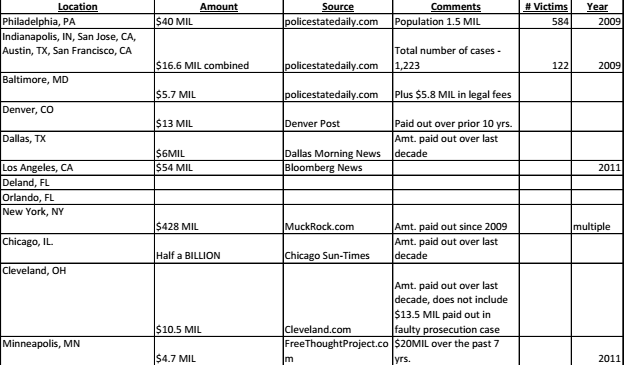
Dollars Paid Out For Police Misconduct (via UU’s Justice of Florida, Justice For All of Central Florida​)

Dollars Paid Out For Police Misconduct
Via Nancy Nordyke Shelley Unitarian Universalist Justice of Florida, Justice For All Coalition of Central Florida​

(click to enlarge)
Dollars Paid Out For Police Misconduct (via Unitarian Universalist Justice of Florida, Justice For All Coalition of Central Florida-)

Posted in Uncategorized | Tagged , , , , | Leave a comment

Advisory: DUI Checkpoint

DUI / DRIVERS LICENSE CHECKPOINT SCHEDULED

The Escondido Police Department Traffic Bureau will be conducting a DUI Sobriety / Driver’s License Checkpoint on Saturday, June 27, 2015.

Posted in Uncategorized | Leave a comment

DNA testing isn’t perfect, and it could get worse, experts say

Martin Yant's avatarWrongful Convictions Blog

DNA testing is the gold standard in forensic science, and it has been used to free hundreds of innocent inmates since 1989. But it has also falsely implicated other innocents, and it likely will do so even more as labs push the technological envelope to solve crimes, the Marshall Project reports here. Add human error to the equation, and you have the recipe for potential disasters.

View original post

Posted in Uncategorized | Leave a comment

SB124: End Youth Solitary Confinement! ltr to Assemblymember Bill Quirk

June 24, 2015
Assemblymember Bill Quirk

Chair, Assembly Public Safety Committee

Sacramento, CA 95814

Via Fax:  (916) 319-3745

Dear Assemblymember Quirk:

I am writing on behalf of United Against Police Terror San Diego to indicate our full support for Senate Bill 124.   SB 124 would: 1. Clearly define solitary confinement – (also known as isolation) – for county and state juvenile lock-ups as confinement in a locked room (dormitory) typically used for sleeping or in a locked cell;  2. Limit the use of solitary confinement to four hours; 3. Eliminate its use as a punishment, group punishment or for youth who have mental conditions; and 4. Require facilities to exhaust all other interventions before confining a youth to solitary confinement.  The law would apply to all county juvenile halls, county probation camps and ranches, and the California State Department of Corrections and Rehabilitation’s youth prison system known as the Division of Juvenile Justice.

California has some of the nation’s harshest conditions in juvenile facilities – including widespread use of solitary confinement – causing lifelong trauma for the youth and families who are impacted.

Studies have shown that youth who experience solitary confinement are more likely to spend time in adult prison, less likely to finish high school, more likely to develop mental illness and/or drug/alcohol addictions as a result of the harsh conditions and sensory deprivation of solitary confinement, and are more likely to attempt or commit suicide.

In the San Diego CityBeat  publication Wednesday, February 4, 2015 “Legislation seeks to end isolation in juvenile facilities” Kelly Davis reports In November, CityBeat wrote about 16-year-old Rosemary Summers, who was found hanging in her room at the Girls Rehabilitation Facility in Kearny Mesa on Sept. 27, 2013. According to records obtained by attorneys representing Summers’ parents in a lawsuit against the county, the teen struggled with depression and panic attacks that were especially acute after she was moved into a single room, where staff reported hearing her talking to herself. In one instance, when Summers refused to return to her room because of severe anxiety, she was punished with 48 hours of room confinement.

In honor of Rosemary and all youth affected, please pass SB 124.

Unless we pass SB 124, across California, thousands of youth, their families and loved ones will continue to experience solitary confinement each year.

Thank you for your attention to this matter.

Sincerely,

Catherine Mendonça, Dir. of Communications, Uaptsd.org

ABOUT SB124

Authored by Senator Mark Leno and co-sponsored by Ella Baker Center for Human Rights, the Youth Justice Coalition, the Children’s Defense Fund – California, and the CA Public Defender’s Association, would drastically limit the harmful practice of solitary confinement (also known as seclusion and isolation) of youth in juvenile facilities. This includes all juvenile halls, probation camps and ranches and the state’s Division of Juvenile Justice youth prison system. The use of solitary confinement would not used for punishment, but only if the youth poses a serious and imminent threat to themselves or others, that isolation be used only after all other interventions have been exhausted, and that the practice be limited to 4 hours.

Francisco Martinez, a youth leader with the Youth Justice Coalition who has been organizing to pass SB 124 experienced solitary confinement at Los Padrinos Juvenile Hall in Downey, CA. “Experiencing solitary confinement as a young teen was horrible – like an animal in a cage. The conditions were a small, dirty concrete room. The walls were covered in dirt and dried up spit, smeared food, tagging on the walls and on the bars of the bed, and covering the windows. The mattress was so ripped up it felt as if I was laying on steel bars. We were kept in our boxers with a tee shirt and socks, and a thin blanket. The cold from the air conditioning blowing 24-7 was freezing torture, but was even worse for me, because I have asthma. I had shortness of breath when I woke up until I went to sleep. When I had an asthma attack, I waited from morning until night to go to the medical unit. I was shaking and never able to get a good night’s sleep.”

Posted in Uncategorized | Leave a comment