The Call for the 19th National Day of Protest to Stop Police Brutality, Repression and the Criminalization

Click here for formatted version in pdf.

OCT22On the eve of the 19th annual National Day of Protest to Stop Police Brutality, Repression and the Criminalization of a Generation, a defiant new spirit is in the air. In Ferguson, Missouri, people continue to rise up in outrage against the killing of Mike Brown, an unarmed 18-year-old Black youth who was just days away from starting college. Despite the rapid and ruthless militarization of the town by racist police and the National Guard, people defied curfews, tear gas, rubber bullets, and calls for a return to business-as-usual—and oppression-as-usual—by protesting and rebelling for ten consecutive, sweltering nights in August. Thousands from around the country gathered in Ferguson this past weekend to stand in solidarity with the brave people of Ferguson. These are the moments where the decades of racist abuse, criminalization, and police terror at the hands of this system came crashing against fearless resistance from the very people it seeks to control, inspiring justice-seeking people not just nationwide, but around the world. The National Day of Protest was founded to oppose exactly these kinds of abuses. This year, in big cities and small towns, in the face of police brutality, repression, mass incarceration and the criminalization of youth we say, Let the spirit of Ferguson ignite hearts nationwide with an uncompromising passion for justice!

In the United States, this year has seen a litany of state violence, with increasing documentation and coverage making these ongoing atrocities more difficult to deny. Over 800 people have been killed by law enforcement nationwide, at least 200 since Mike Brown, and at least 23 people in one week. Although police criminalization of and violence against women and transgender people is nothing new, they have become more newsworthy of late. There seems to be no level too low for law enforcement to stoop in their violence, whether it is against children and young teens, the elderly, the deaf, or those who are emotionally or mentally distressed.

In New York City, the era of mass criminalization of Black and brown communities through “stop and frisk” was supposed to be over thanks to the election of a supposedly progressive mayor. What de Blasio brought instead though, was the return of William Bratton, the architect of Stop and Frisk! Bratton’s highly oppressive “broken windows” style of policing, in which the smallest “crimes” are aggressively policed, has already led to an increase in police brutality and public mistrust. In this year, NYPD’s use of “Broken Windows” has led to the highly publicized chokehold death of beloved community member Eric Garner, the beating of an 84-year-old immigrant man for allegedly jaywalking, a chokehold on a 7-month pregnant woman for barbecuing in front of her home, a young man kicked in the head while lying on the ground handcuffed, numerous people beaten for falling asleep on the subway, a raid of Harlem housing projects, and numerous other atrocities. Even some of the most well-known cultural aspects of New York are under attack, as subway performers are being arrested at astonishing rates simply for trying to earn a living as they have been doing for decades. Meanwhile, the same City Council that voted so strongly for police reforms earlier this year has remained silent in the midst of a new “progressive” administration, lifting their voices only to cry out for 1,000 more cops!

We have seen other attempts at creating some modicum of accountability being thwarted or ineffective, such as the gutting of civilian oversight mechanisms and useless federal investigations of police departments by the U.S. Department of Justice, while those who document police misconduct are under attack. But we applaud the different ways that people have risen up and persevered.

Law enforcement departments across the country have come to use on a routine basis the exertion of military enforcement and control in communities that are deemed a “social disturbance.” Although there has been a long history of the militarization of police, the revelation of just how much military weaponry has been supplied to local law enforcement by the Pentagon and how the uprising in Ferguson was dealt with are a sobering reminder of the capabilities of law enforcement to exert standing army-like control over the population of non-combatant civilians. It also would be a moral crime to ignore the fact that the intensification of police arms and enforcement is borne out of the desire, on behalf of the state, to quell the expression of people of color in their demands for justice.

Through the unabated organizing and pressure from the people, we can rejoice over the release of political prisoners Lynne Stewart and Eddie Conway (and hopefully soon Sundiata Acoli), but we must continue our fight for the many political prisoners who continue to be unjustly locked up, along with the hundreds of thousands imprisoned for non-violent offenses due to discriminatory practices in the criminal justice system. The U.S. has the highest number of prisoners in the world, incarcerating almost one-third of the world’s female prisoners, and having more than 60% of prisoners being people of color – still a minority of this nation’s population. Despite solitary confinement being internationally designated as torture, over 80,000 languish in such conditions, including some as young as 16. Solitary confinement led to a death sentence for some, and more egregious evidence of torture in prisons are now coming to light. This brazen inhumanity is exemplified by border patrol’s abuse of immigrant children seeking safety within our borders, and the warehousing and deportation of literally millions of immigrants by Immigration and Customs Enforcement. Under such a corrupt system, no imprisonments are legitimate!

The Call for a Month of Resistance to Mass Incarceration, Police Terror, Repression and the Criminalization of a Generation declares that this “will not stop unless and until millions of people, of all nationalities, stand up and say NO MORE, in unmistakable terms. The history of this and every other country shows that without struggle, there can be no positive change; but with struggle this kind of change becomes possible.”

October 22nd is a day that people around the nation have mobilized every year since 1996 for a National Day of Protest to Stop Police Brutality, Repression and the Criminalization of a Generation. It is crucial that we bring forward a powerful National Day of Protest in cities and towns across the U.S. to challenge the ongoing violence against the people. This October 22nd, stand with thousands across the country to express our collective outrage, creativity, and resistance in response to the crimes of this system. On October 22nd, WEAR BLACK, FIGHT BACK!     – October 22nd Coalition

_____________________________________________

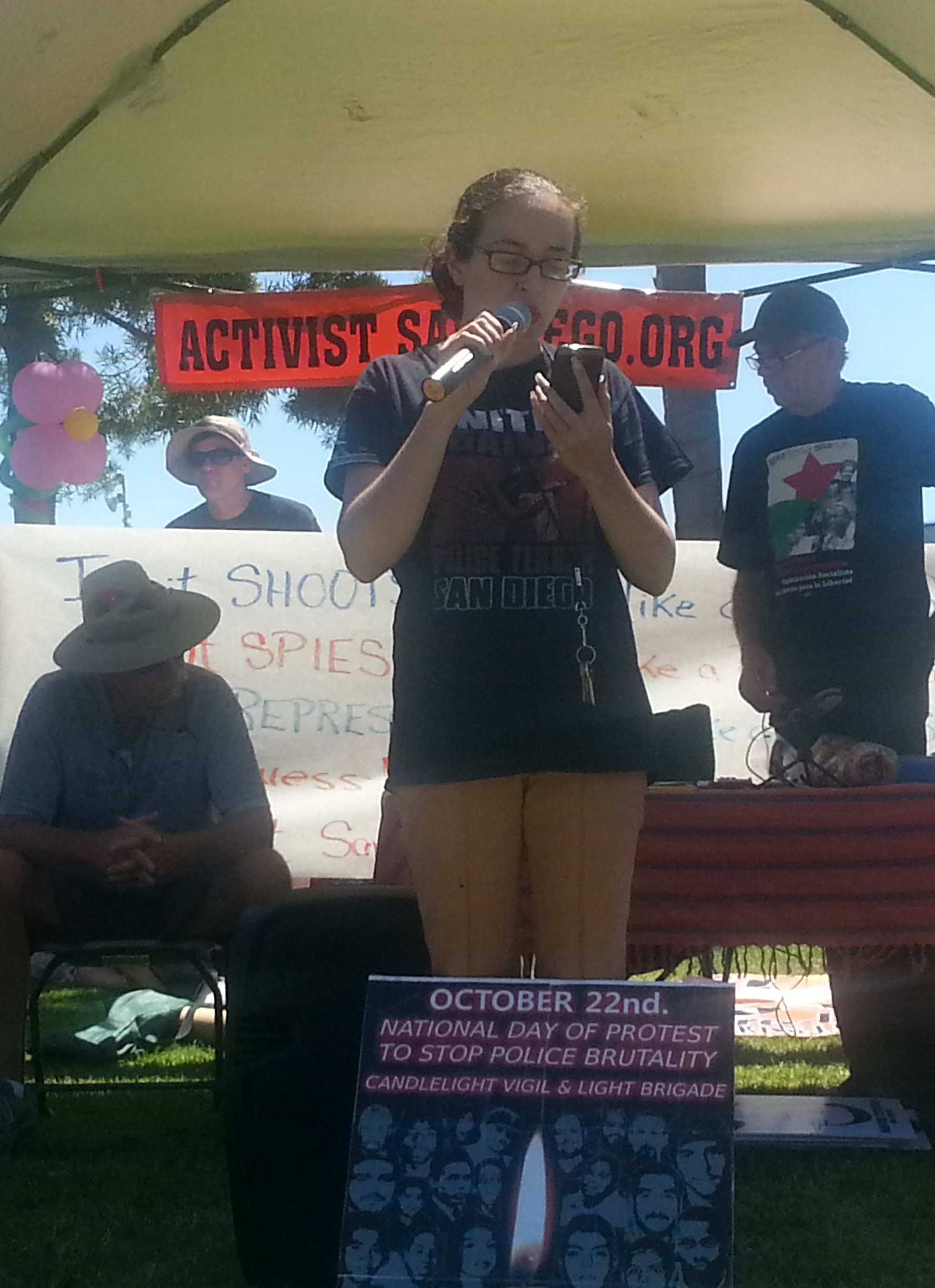
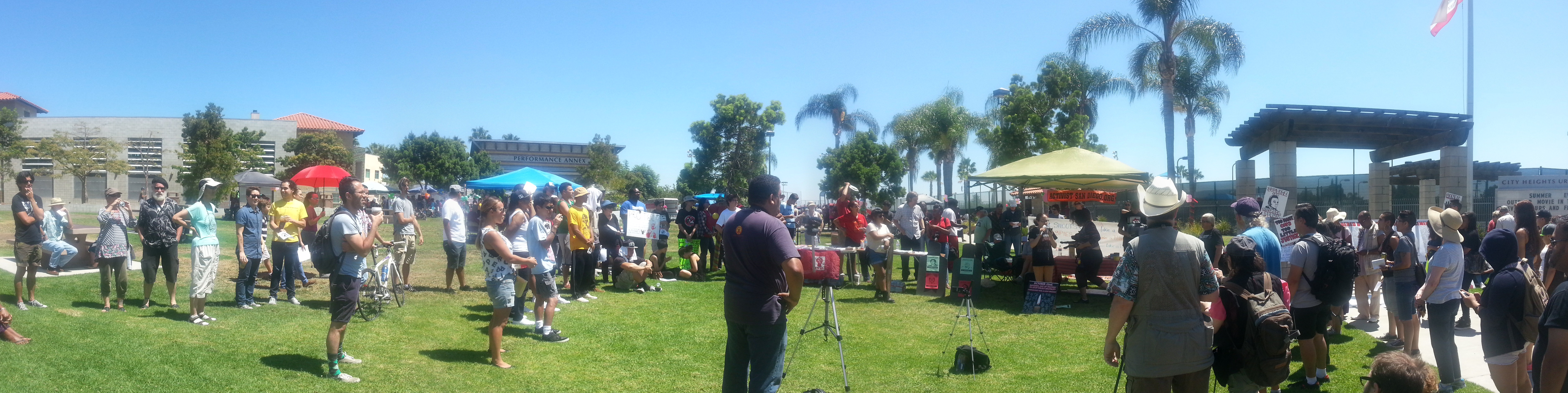
San Diego National Day of Protest Against Police Brutality 

5pm Set up and poster making
6pm Rally at City Heights Performance Annex
Candlelight March to I-15
Continue Rally and Candlelight Vigil
Overpass Light Brigade Message “Stop Police Terror”

Endorsing Organizations
San Diego District of the International Socialist Organization, ACTIVIST SAN DIEGO, Activist SD & KNSJ Team Members, Artful Activist – San Diego, Overpass Light Brigade – San Diego, Discipulus Power (Students in Power)  Students Against Mass Incarceration – San Diego City College     Click here for Facebook Event Page.

O22OLBEVENT

Posted in Uncategorized | Tagged , , , , , , | Leave a comment

MY FAMILY WAS HELD HOSTAGE IN OUR HOME BY EL CAJON SWAT

The below was received anonymously.

The authors point, “that every family has problems and the police often make things worse by making a big scene” is something that many people learn the hard way. Perhaps through a needless assault, kidnapping and caging, or the death of a loved one by someone who may later claim to be “just doing my job.”

el-cajon-police-outfit-swat-copblockIt is hoped that this post, and other  similar outlets, will help make clear that despite the lip-service paid to “protecting and serving,” police employees, per the nature of their institution, are primarily motivated to gain compliance, and thus will escalate up to and including, the use of deadly force. Fortunately, because the author of the post knew and chose to exercise his rights, that’s not how this situation ended.

On August 20, 2013 the El Cajon Police Department S.W.A.T team surrounded my home and barricaded my neighborhood from residents coming in or leaving.

The back story is simply that me and my wife got into a heated argument the night before, she left, was gone all night and I called her sister around midnight (who lives in Rhode Island) because I was growing worried. Her sister hadn’t heard from her and didn’t know her whereabouts. I assured her sister I would keep her informed.

The next morning my wife arrived and we agreed to sit and discuss things calmly. I texted her sister and told her that she got home and was safe. Her sister demanded to speak with her but I informed her that we needed to speak to each other first but I would tell her to call her. Her sister demanded again, this time saying she was going to notify the local police department in five minutes if she didn’t hear from her sister. We thought that was odd and hasty but went on carrying on our conversation and as we were speaking the door bell rang…

I told my wife that it was the police (we saw them on our security cameras) and that we didn’t have to answer our door because police like to escalate situations and that was the last thing we needed…my son (toddler age) opened the blinds out of curiosity and the police officer noticed him and began to bang on my security door like a crime was in progress….then other officers arrived and began to bang on windows too.

At this point I was getting quite annoyed that they were persisting……next thing my phone rings…..I answer it and it’s the police officer outside…..he explained that they were called to a welfare check and needed us to step outside to see if everyone is okay and safe. I told him that they need to go away and our family matters were being resolved by us in a calm manner and no one is being harmed at all. My wife even spoke to him telling him we were all fine.

By this time, the neighborhood was closed off and the department had dispatched more officers, including SWAT. I told the officer via cell phone that we knew our 4th amendment right and didn’t have to comply with their orders. Me and my family were beginning to get agitated and my son was crying because he was tired at this point. It started around 9 AM and was now around noon, which is his nap time.

During the ordeal I spoke with an officer, dispatch officer and a lieutenant and they refused to leave citing they had to make sure everyone is safe. At this point they were treating the situation as a hostage situation and I sternly explained to them that they were being voice recorded, video recorded and I would not hesitate to file a lawsuit if they continued to harass my family.

I informed them that I was no stranger to the criminal justice system (although not a felon and have only had a minor DUI conviction which was expunged) and in fact I had a bachelors degree in that field myself. The officer tried being friendly with me as he noticed my USMC flag in the front of my home and stated he was a former Marine also. I didn’t take the bait as I knew what he was attempting and frankly I didn’t give a damn and didn’t know him anyway.

Four hours or so into the ordeal, I looked to my wife and said “maybe you should go out there and show them you’re safe so they will leave us the hell alone” I sat with her and schooled her a bit on her 4th and 5th amendment (she was not too familiar with them at all) and urged her to only give identification information and to use her right to remain silent to her advantage and to save us from further harassment.

She went outside (I didn’t want to go outside because they knew I had a gun (registered in my name) and would’ve tased me and kicked my ass at the first opportunity. So I felt it was a safer bet to have her confront them.

The were in my back yard, my neighbors back yard and had snipers and police set up all over our small neighborhood block and according to her made her climb a ladder to get to them outside of the yard. They did exactly what I informed her they would do which was interrogate her and ask her questions like “do you guys have drugs, sell drugs, does he have guns, did he hurt you?” etc…they weren’t satisfied and wanted me to send my son outside to and I told them he was sleeping and I wasn’t going to wake him up just to appease them in their little game.

At this point I was pissed off and getting irate with these ass clowns! They urged me to at least show him through the window and they would leave…..I woke him up and showed them my sleepy eyed son (who was awake now thanks to them) and they finally left.
The moral of this story is that every family has problems and the police often make things worse by making a big scene.

My next door neighbors were pissed off and the rest of the neighborhood was annoyed but mostly supportive. The next door neighbors asked me “why didn’t you just do what they said” to which I replied “because we have rights!”

BTW….this was our first year in our new home so you could probably understand how mortified and embarrassed we were at the event that took place. If I could do it again. I would probably do the same thing. I don’t interact with police officers and have lost so much respect for them because of this.

Posted in Uncategorized | Tagged , , , , , , | Leave a comment

Aspiring Actress Charisma Carpenter’s Horrifying Encounter with San Diego Police/Serial Rapist in 1991

By: Aaron Leaf
uaptsd.org

As history has repeatedly shown, none of us are exempt from the brutal and unlawful attacks of Police Officers. Many stories have come to light, including the recent brutal attack on Kelly Thomas by Fullerton Police, the shooting of unarmed Michael Brown in Ferguson Mo, and the tasering of 18 year old Israel “Reefa” Hernandez, which led to his death, only caught for tagging on an abandoned McDonalds in Miami.

Charisma Carpenter Photo courtesy of Investigation Discovery

Charisma Carpenter
Photo courtesy of Investigation Discovery

As the list of victims of police misconduct rapidly grows, one story out of San Diego had the whole town in fear of a serial rapist on the loose who attacked couples on the beaches of San Diego, including an then aspiring actress and former San Diego Charger Cheerleader, Charisma Carpenter known for starring in the TV shows; Buffy the Vampire Slayer and Angel.

On August. 15, 1991, three friends arrived at Torrey Pines State Beach in La Jolla to go for a swim. Although Charisma Carpenter, (22), Arthur Gracia, (24), and Aldo Ochoa, (22), had heard about a lone gunman believed to have raped several women along the coast, they were not especially worried. After stripping down to their underwear, Gracia and Ochoa paddled out into the ocean, while Carpenter was changing at a nearby lifeguard tower, she sensed something lurking in the shadows. She screamed.

“Shut the fuck up,” yelled a voice from the dark. Ochoa and Gracia, hearing Charisma’s scream, emerged from the water and ran to Carpenter’s aid. “Sit the fuck down,” ordered the man, and then he ordered Carpenter to tie up Gracia and to bind Ochoa’s hands with his belt. She hesitated as the attacker jammed a pistol to her temple. When she began to whimper, he handed her his heavy-duty flashlight and knelt to do the job himself. Courageously, Arthur Gracia lunged at the gunman. Startled, he shot Gracia in the chest, but Gracia kept hitting. Ochoa jumped in but was shot in the abdomen and wandered off. As Gracia grappled for the gun, it went off a third time, blasting a hole in the attacker’s left hand. The gunman staggered into the night, and the three friends, although traumatized, were able to get to a convenience store in Ochoa’s Jeep and call for help.

hhHenry Hubbard Jr., a 30-year-old “supercop,” was viewed as exactly the kind of officer capable of capturing the rapist who had been terrorizing San Diego for months. A former minor-league baseball player for the San Diego Padres, he starred in a local TV documentary, The Making of a Cop, in 1987. In 4½ years as an officer, he had won commendations.

Patrolling on the 2 p.m. to 1 a.m. shift, He had the ability to “carefully monitor” the investigation of attacks at local beaches. He was virtually the last person the police might have suspected to be the man they were hunting for.

But at 4:30 a.m., Hubbard and his wife, walked into the UCSD Medical Center for treatment of his bloodied hand. His story to doctors was his car had broken down and that he had been jumped by “two or three men.” Investigators grew suspicious when they noticed sand on Hubbard’s clothes. Doctors found bite marks on Hubbard’s back and ear that matched Ochoa’s teeth (undergoing emergency surgery at Scripps Hospital two miles away). The clinching piece of evidence was his police-issue flashlight, his name engraved on it, which Carpenter had brought from the beach. At 2 p.m., Hubbard was arrested and later taken to jail.

After maintaining his innocence for almost a year, Hubbard pleaded guilty to eight violent sexual assaults and two attempted murder charges. He was eventually sentenced to 56 years in prison.

The series of vicious beach attacks began on June 15, 1991. At 3 a.m., a young couple were resting under a blanket at Del Mar Beach, when a masked gunman robbed them and raped the woman at gunpoint. On July 4th the gunman raped a woman at Solana Beach, On July 20, at Windansea Beach, Hubbard had two young girls truss up their older male friend. Then he repeatedly raped the girls, aged 13 and 14. While assaulting the 13-year-old, the attacker said, “Why don’t you get into it a little bit?” Then he asked the 14-year-old if she was a virgin. When she answered yes, he replied, “We’ll change that.” He then attacked her while the two girls cried.

The police grew frustrated as the rapist seemed to anticipate their every move. When cops staked out decoy teams on beaches to the north and south, he would strike in between. Detectives noted that the rapist always followed the same eerie modus operandi. “By forcing the female victim to tie up the male, he gave the initial impression that it was a robbery,” says San Diego Sheriff’s Det. Floyd Feese. “In fact his sole purpose was to destroy the state of mind of (the couple). He did to his victims what a cat would do to a mouse: He played with them, terrorized them.”

In each case, at least one man and one woman were victims and they were either robbed or a robbery was attempted. Women were sexually assaulted in four cases and rape was attempted in a fifth. There were five robberies and two robbery attempts. All of the attacks occurred between 1 a.m. and 4 a.m.

By the time of the grand jury hearing, Hubbard had been identified in six rapes and two rape attempts. Later, DNA samples of semen and blood linked him to another unsolved rape. At first, his lawyers maintained that vindictive cops had set Hubbard up in retribution for testifying against a fellow officer in an excessive-use-of-force case.

But in July, facing more than 200 years in prison if convicted by a jury, he pleaded guilty or no contest to all charges. “Henry never wanted to put the victims on the stand and to have to go through it,” says Hubbard’s lawyer, Kerry L. Steigerwalt. Citing Hubbard’s decision, the judge sentenced him to only 56 years, which may make him eligible for parole in 28 years. “Henry’s a smart man,” said Steigerwalt. “He knew what the prosecution had, and what we had. If he was convicted, he would have died in prison.”

Those who knew Hubbard were dumbfounded. Raised in Lancaster, S.C., the son of a school administrator and a teacher, Hubbard was an over-achiever and was known to be especially kind In women. His police friends in particular were shocked. “There was nothing odd about the person I knew,” says Craig Myrom, Hubbard’s partner for 4½ years. “That’s what’s scary—being able to function in society while still being capable of committing these crimes.”

Hubbard’s wife, Karen, 32, is also one of his victims. “It was emotionally devastating to have someone tell you your husband’s been arrested,” she says. After driving Hubbard to the hospital and finding out he was charged with the rape series on the news, she became physically sick. Since then, Karen has received death threats, declared bankruptcy and seen their 2 year old daughter, become hurt and confused. “He was a great dad,” she says. “Now Samantha wants to know where her daddy is. How can a person you met eight years ago change so much?” asks Karen

Hubbard sat stoically through the sentencing, though when addressing the court, he wept. “I deeply regret that I am responsible for causing such pain,” he said. “I realize that you may never forgive me…. I have no excuses to give you, as the acts are inexcusable.”

The victims, however, were hardly appeased. A “model cop” who was also a vicious rapist has made it difficult, they say, to trust anyone again. One rape victim remains confined to a mental health facility. Charisma Carpenter is still coping with emotional trauma, while Aldo Ochoa still has a bullet lodged in his liver. “He’s a rapist,” said Arthur Gracia, who had a bullet removed from his back. “He deserves to rot in prison.”

Charisma Carpenter has since become a well known actress and is now the host of “Surviving Evil” where she has shared her horrifying story through witness testimonies and reenactments. Watch the Full Episode of “Surviving Evil: Terror Beach” below.

Resources

Police Officer Suspected in Series of Rapes : Crime: A San Diego patrolman is arrested after an early-morning attack and shooting at state beach.

Remembering the terror of a San Diego beach serial rapist more than 20 years ago

Charisma Carpenter, “You can have a good life even after something terrible happens

Posted in Uncategorized | Leave a comment

“Speak their Names” Part of the Nationwide Justice for Michael Brown in San Diego

By: Nadin Abbott                                                                                                                 Reporting San Diego

Aug. 30, 2014 (San Diego) About 60 people from different walks of life came to the “Officer Jeremy Henwood Memorial Park” in City Heights, behind the Weingart Library and Performance Annex. The goal of the meeting was to remember those who’s “lives were stolen” by the action of the police.

Cathy Mendonca UAPTSD photo by: Aaron Leaf

Cathy Mendonca UAPTSD
photo by: Aaron Leaf

We spoke with Cathy Mendonca, member of United Against Police Terror, after the march through the neighborhood. she explained to Reporting San Diego that what happened at Ferguson, Missouri was “not unique to Ferguson and possibly opened the eyes of many individuals. Ferguson is only one example of how the police are heavily militarized.”

(See link to our review of police militarization in San Diego)

The police are using military grade weapons against people who are exercising their rights to protest. She added, “the police are reactionary, and their tactics are to use force rather than not use force.” She added that the police is not trained not to use force.

Mendonca also explained some of the issues that people deal with regularly. She said that the officers have zero tolerance policies in schools, as well as curfew policing, to funnel the children into the system early. She also said that the children have rights under the Constitution, but the officers are not going to remind the children about those rights, nor are the children taught them early.

In her view, children are swept into the system early, and parents at times have to pay for special diversion classes. The community of City Heights is lower middle class, and $500 is a lot of money.

As far as gangs, she also explained that the standards for law enforcement to link a young person to gangs is very low. Therefore it is easy for youth to enter the system that way.

Mendonca also does not encourage a relationship with the police because the police cannot be trusted. Part of the reason is that her group, Stop Police Brutality, has been able to find 180 victims in San Diego so far.

Speak Their Names Photo by: Aaron Leaf

Speak Their Names
Photo by: Aaron Leaf

San Diego has a history of tension between communities and the police. One event that led to the establishment of the Civilian Review Board back in 1992, was the Sagon Penn case in 1985.

According to The New York Times Reporting after he was acquitted:

A white former officer, one of 48 defense witnesses, had described Officer Jacobs as ”the most prejudiced white person I’ve ever known.”

Although Mr. Penn did not testify, jurors heard taped statements that he made shortly after he was arrested. At that time he said he pointed the gun at Officer Jacobs in hopes of getting the officer to stop hitting him, and that the gun went off when the officer hit him in the arm.

The case provoked angry denunciations from black leaders, who accused the police department of insensitivity to minorities.

While the case at the time did not lead to the conviction of Penn, it did lead to a lot of tension during that summer. But the tensions remained in the community. After some time, a civilian review commission was born, in 1989. The commission that was envisioned and what exists today are very different.

As “Arrow” pointed out, The commission “it does not really work.” One of the reasons he said that it does not work, is the fact that it has no subpoena power, no actual review power, and the civilian commissioners need to rely on the Police Internal Affairs Department.

This makes it almost useless, and more for show than real oversight.

We are including the video testimony in full from Shakina Ortega. Officer Jonathan McCarthy shot her husband in 2011 in Mira Mesa.

The American Civil Liberties Union (ACLU) has a manual here, for civilian oversight that you might find useful.

Posted in Uncategorized | Leave a comment

Police Terror Against the Mentally Ill

***Trigger Warning***

#stateviolenceagainstthementallyill
#Abelism #SmashEugenicistsculture #abelnormativesurpremacy #policeterror
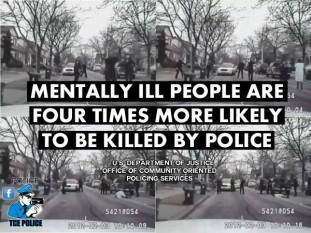
10390053_745385018817278_5012663616346593585_nUnited Against Police Terror – San Diego is committed to educating the community that #stateviolence against the #mentallyill and #disabled, which many times lead into the #prisonindustrialcomplex, is a direct reflection of #abelnormativesurpremacy ideologies by the ruling class. Not only are policing and prisons based on systems of power, NOT sickness, but the treatment of mentally ill by these systems of power tells us that the sick and disabled are to be eradicated, not treated or integrated interdependently in our communities.

#PROOF OF #OPPRESSIONWEMUSTDISMANTLE #MENTALILLESSISNOTACRIME

If you’re fighting against police brutality but still carry out ableist ideologies, YOU’RE perpetuating the same ideologies from the ruling class carried out BY COPS who are (physically and mentally) brutalizing our communities.
#Abelismandvictimsupportdontmix
– United Against Terror #Uaptsd.org

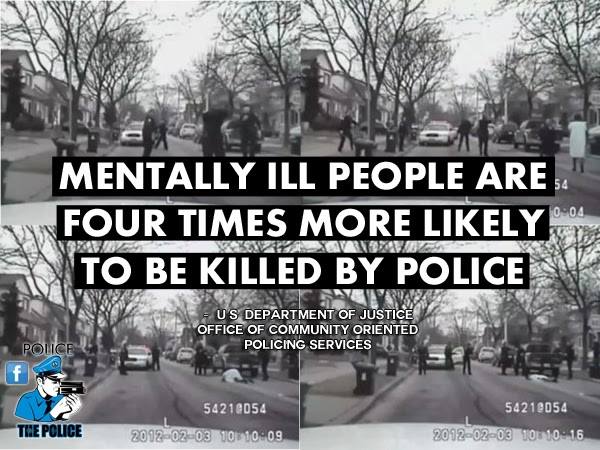
Mentally Ill Four times More Likely to Be Killed by Police
Added by David Arroyo on October 8, 2013.
Saved under Crime, David Arroyo, Health, U.S.
Read more at http://tinyurl.com/l6bsvuj

Mentally ill and murdered by police
Hannah Wolfe documents a little-noticed epidemic of police killing the mentally ill.
http://tinyurl.com/nhxch4b

Neglected Issues — Police Killings of the Mentally Ill and the Lack of Police and Mental Health Relations http://tinyurl.com/lz64fvj[/

Untreated Mentally Ill Killed by Law Enforcement 2012-2/2013
http://tinyurl.com/n4mn3of[/

As the mental health system continues to refuse to treat the most seriously ill, they become a police responsibility. It is often a dangerous responsibility because individuals who refuse treatment may not be taken into custody or to a hospital until after they become danger to self or others. Rather than prevent violence the law requires it. This means officers are often walking into a dangerous situation. Most of the time these situations resolve safely. Sometimes officers are hurt or killed. Other times, it is the person with mental illness who is hurt or killed. Many mental health advocates blame police for these incidents. We believe the fault is within the mental health system. Almost all these individuals were known to be mentally ill but were not receiving treatment. Following are some stories of police walking into dangerous situations involving people with untreated mental illness that escalated and resulted in the person with mental illness losing their life. They are culled from a database maintained by the Treatment Advocacy Center.

Denver, Denver, CO
On November 10, 2012, 38-year-old Jeffrey Albert Musick attacked an Auraria campus officer with a sword was fatally shot by officers. Musick, who had a history of mental illness, had been at two different psychiatric facilities shortly before the incident.

Bay Minette, Baldwin, AL
On November 26, 2012, 53-year-old Michael Jansen was fatally shot by police at his home during a shootout with three deputies. Also killed was 47-year-old Deputy Scott Ward. Sgt. Curtis Summerlin was shot in the leg. Jansen’s mother called 911 because she was concerned about her son’s well-being. Jansen had a history of mental illness. His mother had petitioned in 2009 and twice in 2010 to have her son committed to a state hospital.
Birmingham News, 11/26/12

Oxnard, Ventura, CA
On August 14, 2012, Oxnard Police responded to a call that 36-year-old Michael Mahoney, diagnosed with schizophrenia, was standing in the middle of a street with a gun to his head. Police tried to resolve the situation but opened fire when Mahoney challenged them. KEYT, 12/6/12; Bloomberg News, 12/28/12

San Bernardino, San Bernardino, CA
On December 8, 2012, Police were called to a Cal State San Bernardino on-campus dorm after a report of a disturbance involving Bartholomew Williams, a grad student,in the common area. Williams became violent and attacked one of the responding officers. He was then fatally shot by police. Williams was diagnosed with bipolar disorder and not taking his medication. KTLA News, 12/10/12; Los Angeles Times, 12/11/12

Corpus Christi, Nueces, TX
On December 9, 2012, 56-year-old Daniel Scott, who had a history of mental illness, called 911 and said he was armed with a weapon and had barricaded himself inside his house. He was fatally shot by police after a standoff.
KRIS TV, 12/10/12

Anaheim, Orange, CA
On January 19, 2012, 29-year-old Roscoe Cambridge approached a police sergeant in his car wielding a large knife and carrying a Bible. Cambridge’s family said he had been diagnosed with schizophrenia but refused to take medication. He was fatally shot by a police officer who felt threatened. ABClocal.go.com/KABC, 1/20/12; Orange County Register, 12/14/12

Tulsa, Tulsa, OK
On April 3, 2012, 45-year-old Bobby Dale Sutton, who had a history of mental illness, charged at police with a knife inside his apartment. He was fatally shot by police. Tulsa World, 4/4/12

Portsmouth, Newport, RI
On February 3, 2012, 25-year-old Craig J. Raposa became combative when police tried to convince him to go to a hospital for a psychological evaluation. He died during the struggle with Portsmouth police, in which pepper spray was used. Authorities said Raposa HeraldNews.com, 2/8/12; Patch.com, 4/13/12, 1/10/13

Clovis, Fresno, CA
On April 13, 2012, 40-year-old Christopher Machado fatally shot his mother, 73-year-old Edith Machado, and a neighbor, 60-year-old Vernon Eugene Lindsay, before he was fatally shot by police. Machado was mentally ill and was acting strangely in the hours before the shootings. Fresno Bee, 4/13/12

Keyes, Stanislaus, CA
On April 16, 2012, Stanislaus County sheriff’s deputy responded to reports of a family fight involving 32-year-old Jorge Ramirez and fatally shot him. His aunt said he was prescribed medication, which he took for a while and which seemed to help. But then he stopped. Modesto Bee, 4/17/12

Panama City, Bay, FL
On April 22, 2012, Clifton McKinney, a mentally ill man armed with a machete was shot as he charged at officers. According to reports detailing the police deparmtment’s numerous prior contacts with McKinney, he had a history of mental illness and violence toward police. News Herald, 4/25/12

Mt. Carmel, Sullivan, TN
On May 12, 2012, 47-year-old Ernest France pointed a shotgun at his wife and threatened to kill her. Kingsport Police tried to negotiate a safe surrender with France for more than a half hour before he aimed a gun at them and they shot back. France was bipolar disorder and wasn’t on his medication at the time. TriCities, 5/14/12; Times News, 11/28/12

Manhattan, New York, NY
On January 3, 2013, 37-year-old Peter Jourdan opened fire on two plainclothes police officers who shot back and killed him. Jourdan’s family said that despite numerous trips to jails and hospitals, Jourdan diagnosed with schizophrenia, had been routinely sent back to the streets instead of taken someplace for treatment. New York Daily News, 1/5/13; NewYork.CBSLocal.com, 1/6/13; Morning Call, 1/15/13

Tamarac, Broward, FL
On January 9, 2013, 60-year-old Linda Sue Davis, diagnosed with bipolar disorder, fatally shot her neighbor, 75-year-old Jolene Shamburg, in their 55-and-over community and was then fatally shot by police when she refused to comply with a Broward Sheriff’s Office Deputy’s orders to drop the weapon. Davis’ family said she had been involuntarily hospitalized for mental health evaluations three times since 2009. Police had visited her home 79 times since 2008 and flagged her as a mentally ill person with a warning to “approach with extreme caution.” Tamarac Talk, 1/10/13; Miami Herald, 1/10/13; Sun-Sentinial.com, 2/3/13

Charlotte, Mecklenburg, NC
On January 6, 2012, 55-year-old Spencer Mims III became angry and erratic at his father who called police. Responding officers found the younger Mims holding the boxcutter to his throat. He refused orders to drop the weapon. Officers shot him when he advanced toward them. Charlotte Observer, 1/30/13

Copperas Cove, Coryell, TX
On February 2, 2013, police responded to a domestic disturbance call and found 24-year-old Kristofer Gagliardi wielding a knife which he had used to cut his wrists. Gagliardi’s was diagnosed with bipolar disorder and his mother said he told the officer to “go ahead and shoot me” and used a racial slur. He did not drop his knife at which point the officer opened fire. KWTX, 2/5/13

Dandridge, Jefferson, TN
In December 2012, 41-year-old Robert Lynn Human, Jr. called 911 and asked to be taken to a mental hospital. When deputies arrived at his home, Human charged the officers with a gun in each hand. Officers fired, killing Human on the scene. Human’s sister said Human, diagnosed with bipolar disorder, went from hospital to hospital looking for help. She said Human had stopped taking his medication and the day after he was killed he had another appointment scheduled at a mental health facility. The appointment had taken six months to set up. 6 News, 2/18/13

Rosemead, Los Angeles, CA
On January 3, 2012, 40-year-old Jazmyne Ha Eng became involved at an incident in a treatment facility and when police arrived she attacked a deputy with a hammer and was fatally shot by a sheriff’s deputy. Eng had a long history of mental illness. Staff members believed she was off her medication at the time. Pasadena Star-News, 1/5/12; SGV Tribune, 1/17/12, 2/4/13

Buttonwillow, Kern, CA
On January 26, 2012, two Kern County Sheriff’s deputies responded to a call from 18-year-old Christian Chavez’s caseworker, who phoned 911 after Chavez made suicidal comments. Police fatally shot Chavez after he pulled a knife out his pocket. Chavez’s family said he suffered from depression and schizophrenia.
Bakersfield Californian, 1/26/12; Huffington Post, 2/10/12

Moorpark, Ventura, CA
On January 27, 2012, 47-year-old Eric Strosser’s father and sister called 911 and said he was out of control. When police arrived Strosser rushed at detectives with a machete and was fatally shot. Guns had been removed from the residence after a 2007 incident in which deputies responded to the home and took Strosser to a mental health facility. Ventura County Star, 1/30/12

Headland, Henry, AL
On January 31, 2012, police responded to a medical call during which 33-year-old Patrick Fitzgerald Humphrey assaulted two paramedics. Humphrey attacked the first police officer to arrive on the scene. Humphrey was combative and was shot when he charged at officers. Humphrey’s family said he suffered from a mental illness, and had already assaulted a family member earlier that morning. He wasn’t taking his medication at the time. Dolthan Eagle, 1/31/12, 4/11/12, 5/11/12, 1/29/13

Las Vegas, Clark, NV
On February 1, 2012, 23-year-old Jason Baires killed his mother’s boyfriend, 50-year-old Rodolfo Velasco-Bayardo, with a machete and was subsequently fatally shot by police when he came out of his vehicle shooting at them. Baires had become paranoid and was seeking treatment for mental illness.
Las Vegas Review-Journal, 2/3/12

Alexandria, Rapides Parish, LA
On February 6, 2011, 22-year-old Robert Ricks grandmother called 911 for assistance because she observed Ricks was in physical distress. When the rescue unit arrived, Ricks became combative and was tasered when he refused to put his feet in the police car and later while sheriff’s deputies attempted to book him into the Rapides Parish Detention Center. After the second tasering, Ricks’ body went limp, he stopped breathing and died. Ricks suffered from bipolar disorder and schizophrenia, and had been released from a treatment center earlier in the week.
The Town Talk, 2/7/12

Pompano Beach, Broward, FL
On February 13, 2012, 53-year-old Kenneth Shewey showed up at his ex-girlfriend’s home and neighbors called 911 after hearing loud arguing. Shewey had pointed his .45 caliber handgun at someone and also fired one shot into the air. He was fatally shot by a police officer. Shewey’s niece said he suffered from mental illness and she had encouraged him to get treatment and medication.
Sun Sentinel, 2/15/12

Hialeah, Miami-Dade, FL
On February 18, 2012, officers were sent the apartment complex of 48-year-old Luis Enrique Nunez after someone called police to say a man was armed and agitated. Nunez was armed with a flare gun and after an exchange, officers opened fire on Nunez. Nunez’ sister said he had a history of mental illness and paranoia but hasn’t been on medication or in therapy for years.
CBS Miami, 2/19/12; Miami Herald, 4/13/12

Pittsburgh, Allegheny, PA
On March 8, 2012, 30-year-old John F. Shick stormed into a lobby at the Western Psychiatric Institute and Clinic, located several blocks from his apartment. He fatally shot 25-year-old Michael Schaab, a nurse, and wounded seven other people. Shick was fatally shot by police during the incident. He had a long history of mental illness. WTAE.com, 3/9/12; Pittsburgh Tribune-Review, 3/13/12; Pittsburgh Post-Gazette, 3/13/12, 3/29/12; Post-Gazette.com, 5/6/12; Seattle Times, 3/28/12

Bayonne, Hudson, NJ
On March 21, 2012, a relative asked police to check on 62-year-old Mariano Vargas who had a history of mental illness. Vargas refused to open his door and a one-hour standoff ensued. Police forced their way into the home where they found Vargas in the living room with a knife. He threatened to kill them and began swinging the knife at which point, officers opened fire and killed him.
Jersey Journal, 3/22/12

Phoenix, Maricopa, AZ
On June 4, 2012, a man visiting the Telephone Pioneer Park Pool with two children called police after 25-year-old Timothy Sean O’Brien became belligerent and threatened the man and his daughter with a bat outside the building. Police said they gave multiple warnings to stop and put the bat down, but he continued to move toward them while swinging the bat. Two officers fired their guns multiple times at O’Brien and killed him. O’Brien’s mother said her son was diagnosed with bipolar disorder. Arizona Republic, 6/5/12

Memphis, Shelby, TN
On June 12, 2012, police found 19-year-old Christian Freeman armed with a knife and refusing to drop it. Freeman charged them and two officers shot him to death. Freeman had been diagnosed with paranoid schizophrenia.Commercial Appeal, 6/18/12

Rochester, Monroe, NY
On June 21, 2012, Israel Andino called Rochester Police officers and said he’d just stabbed his mother. Responding officers encountered Andino in the street. When he fired a round at them, they returned fire killing him. Andino’s stepfather said he suffered from bipolar disorder and was off his medication.
WHEC, 6/21/12

Broomfield, Broomfield, CO
On June 28, 2012, 12-year-old Kyle Miller family called 911 saying he had a knife and was trying to harm himself. Miller pointed a fake gun at officers in the street was fatally shot by Bloomfield police. He had struggled with schizoaffective disorder. The family had pushed to hospitalize their son on several occasions because of self-destructive behavior, but the Boulder mental health center had not allowed it. Denver Post, 6/29/12; Bloomfield Enterprise, 7/6/12, 9/6/12

Jamaica, Queens, NY
On March 15, 2012, 30-year-old Shereese Francis family called for assistance to get her to the hospital. Francis, who wasn’t taking the medication prescribed for her schizophrenia, had become emotionally distraught. Before an ambulance arrived, four police officers cornered her in a basement bedroom, forcing her face-down on the bed and applying pressure while they cuffed her. Within 20 minutes of police arriving, Francis had stopped breathing. A few hours later she was taken to Jamaica Hospital, where she was pronounced dead.
Gothamist.com, 4/3/12; Village Voice, 6/26/12

Hampton, NA, VA
On July 1, 2012, 26-year-old Bryant Weiford charged at officers with a baseball bat he had used to strike a patrol car and refused to their orders to drop it. He was fatally shot by police. Weiford suffered from bipolar disorder with psychotic features, had been hospitalized twice and recently run out of medication. Daily Press, 7/3/12, 7/6/12

Tukwila, King, WA
On June 30, 2012, 25-year-old Victor Duffy Jr. mother said he called 911 during a fight with his younger sister. The scene was “chaotic” with family members yelling at each other. Within minutes, after officers determined that he needed to be involuntarily committed to a mental-health facility, Duffy Jr. was swinging at police and refusing to comply with their attempts to pat him down for weapons. Police used Tasers and pepper spray to subdue him, but he continued to fight police until they managed to handcuff him and strap him on a gurney. He died later in the day. Seattle Times, 7/2/12, 2/28/13

Pensacola, Escambia, FL
On July 6, 2012, Two deputies were sent to the home of 51-year-old James Kirkland Jr. after Kirkland’s mother called the Lakeview Center, the mental health facility where he was treated, to say her son was extremely distraught. Someone from the Lakeview Center then called 911. They found Kirkland standing outside with a rifle in his hand which he pointed at deputies after which he was shot. He had a history of schizophrenia, anxiety, and bipolar disorder.
Pensacola News Journal, 7/7/12, 10/12/12

Knoxville, Knox, TN
On July 6, 2012, Police when responded when 47-year-old mentally ill Paul Edward Capps, mother called and said he was assaulting her. Capps attacked the first officer to arrive on the scene who attempted to use his Taser. It did not stop the assault and police shot and killed him. knoxnews.com, 7/7/12; WBIR, 7/8/12; Knoxville News-Sentinel, 10/12/12
Riverside, Steuben, NY
On August 1, 2012, 38-year-old Charlene M. Fears stabbed her 4-year-old grandson, Roderick Geiger III who died after being taken to Women & Children’s Hospital. She was fatally shot after she lunged at a Buffalo police officer with a pair of butcher knives. Fears had a history of mental illness.
Buffalo News, 8/2/12; Washington Post, 8/2/12

Madison, Madison, AL
On August 4, 2012, a report that 55-year-old Deborah Jo Day was walking down the street with a pistol and threatening to shoot her neighbors. Day, who had a history of mental illness, pointed a pistol at police and was shot by them. Day had suffered from mental illness and recently stopped taking her medication.
Huntsville Times, 8/4/12

Decatur, Morgan, AL
On August 13, 2012, 36-year-old Mister Bobby Lowe was intoxicated, harassing a female living in one of the apartments, and threatening neighbors with a 2×4. Police found Lowe armed with a handgun in the parking lot. Lowe attempted to grab a rifle from a responding officer who pulled his own handgun and shot Lowe. Lowe suffered from bipolar disorder. WHNT, 8/14/12

Gladstone, Clackamas, OR
On August 14, 2012, police responded to a report that 23-year-old Michael Justin Evans was being aggressive in the home he shared with his grandmother and shot him. Evans led a troubled life gripped by mental illness. Police had been dispatched to his home 10 times in the past 20 months to investigate domestic disturbances, criminal mischief, noise complaints, suicide attempts and threats. Evans’ former girlfriend had filed for a restraining order against five months ago before his death in which she described him as emotionally unstable.
Oregonian, 8/16/12

Oktibbeha, MS
On August 20, 2012, 33-year-old Damion Street stabbed an officer and was fatally shot by an officer during a confrontation. He had a history of mental illness.
CBI, 8/21/12

North Bergen, Hudson, NJ
On September 1, 2012, 47-year-old Daniel Plato-Jacobo threatened to harm himself and others with broken glass outside the apartment before running into the building. He lunged at responding North Bergen police with a kitchen knife and was fatally shot by them. Plato-Jacobo suffered from mental illness. The Record, 9/2/12

Walnut Creek, Contra Costa, CA
On September 4, 2012, 36-year-old Christopher Boone Lacy fatally shot a California Highway Patrol officer, 37-year-old Kenyon Youngstrom who had stopped Lacy for an obscured license plate. Lacy was then fatally shot by a fellow officer. Lacy had bipolar disorder. Contra Costa Times, 9/6/12; Monterey County Herald, 9/6/12

Glendale, Los Angeles, CA
On January 5, 2012, 38-year-old Richard Hughes girlfriend called paramedics reporting he had overdosed. After police arrived, Hughes came out of his home holding a knife. Police shot him after he refused to drop it. Hughes had bipolar disorder. Glendale News Press, 9/13/12

Bernalillo, NM
On September 20, 2012, Samuel Jason Marquez, who suffered from mental illness, went to his mother’s house to get money. His mother had a restraining order against him, so she called the sheriff’s office for help. When deputies arrived, Marquez came out of the house with his mother as a hostage, holding a knife to her throat. Marquez wouldn’t negotiate with deputies who then shot him.
KOB, 9/21/12

Houston, Harris, TX
On October 11, 2012, a 911 caller told police that 38-year-old Kenneth Brian Releford broke into their home and beat up an 87-year-old man and his two grandchildren, ages 12 and 14. Police went to Releford’s home and ordered him to come out with his hands up. Police said Releford kept one arm behind his back while yelling at them, despite the officer’s repeated verbal commands. Police fatally shot Releford who had schizophrenia and may have not been on his medications at the time of his death. KHOU, 10/11/12

Charlotte, Mecklenburg, NC
On September 14, 2012, 26-year-old Clay McCall’s grandmother locked him out of her house saying she couldn’t control him. She then called a mental health caseworker, who called police. McCall charged at the officer with 10-inch garden shears and was fatally shot by the officer. McCall was diagnosed with schizophrenia and had a history of violence. Charlotte Observer, 10/12/12

Oklahoma City, Oklahoma, OK
On September 26, 2012, police responded to a call that 43-year-old Timothy Dennis had fired off a gun. Dennis refused to comply with the officer’s commands, forcing the officer to use his taser. He had trouble breathing, was hospitalized and died three days later. He suffered from paranoid schizophrenia bipolar syndrome, and was off his medication. newson6.com, 10/14/12

Rockford, Winnebago, IL
On October 11, 2012, 18-year-old Logan Bell’s family called 911 fearing he would hurt himself. He pointed what appeared to be a real gun at officers who fatally shot him. It was a pellet gun. Bell had bipolar disorder and had stopped taking his medicine. Rockford Register Star, 10/19/12; Rockford Register Star, 10/20/12; WIFR, 1/17/13

Date: 2/2013
Tulsa, Tulsa, OK
On February 16, 2013, 31-year-old Juan Antonio Gonzalez chased his roommate out of their apartment with a knife. Responding officers fatally shot Gonzalez when pointed a rifle at them that turned out to be a BB gun. Gonzalez had bipolar disorder, was off his meds and hadn’t slept for three or four nights. Gonzalez refused to get help, even jumped out of the car on a trip to the hospital.
News on 6, 2/19/13

Date: 2/2013
Rancho Cordova, Sacramento, CA
On February 18, 2013, 35-year-old Paul Tereshchenko’s relatives called police after Tereshchenko refused to leave when asked to do so. Responding deputies said that Tereshchenko was incoherent, erratic and qualified for an 72-hour involuntary psychiatric hold because he could not care for himself. When deputies tried to take him in, he became “resistive and combative.” Fearing for his safety and the safety of his partner, one of the deputies fatally shot Tereshchenko. Sacramento Bee, 2/20/13

Date: 2/2013
Allentown, Lehigh, PA
On February 21, 2013, police responded to the house of 44-year-old Saturnino Perez De La Rosa when neighbors called police about a disturbance. He was fatally shot by police while he was wielding a machete. De La Rosa was diagnosed with schizophrenia and his brother reported he had called police the day before the shooting to try to have him hospitalized but police said that at that time, they could not force him into treatment because he had not committed a crime.
Express-Times, 2/22/13

Date: 2/2013
South River, Middlesex, NJ
On February 23, 2013, 51-year-old Kevin Michael McGlyn was brandishing a knife and threatening two men in his apartment parking lot. He was shot by police. McGlyn who had schizophrenia and bipolar disorder and was not taking his medications, died the next day. Star Ledger, 2/25/13

Date: 2/2013
Seattle, King, WA
On February 27, 2013, 21-year-old Jack Keewatinawin’s, two brothers called police after they had both received disturbing phone calls from their mentally ill brother, who raged about an imagined attack and stolen money. Police believe they were called to a hostage situation involving a hulking and violent mentally ill man who was holding a knife to his father’s throat and had assaulted police in the past. Police say he had threatened an officer with a piece of rebar, which prompted the officers to open fire fatally shooting him. He had schizophrenia and had stopped taking his medication two months before the shooting. Seattle Times, 3/1/13

Date: 3/2013
Kelso, Cowlitz, WA
On March 2, 2013, 26-year-old Jesse Ryan McMillan, was involved in a car crash and fled the scene. Police traced him to the home where he hid in the bedroom. He burst from a bedroom in a home and opened fire on them they returned fire and fatally shot him. Jesse was recently released from jail, where he had not been allowed to take his medication for mental illness. Daily News, 3/2/13

Posted in Uncategorized | Leave a comment

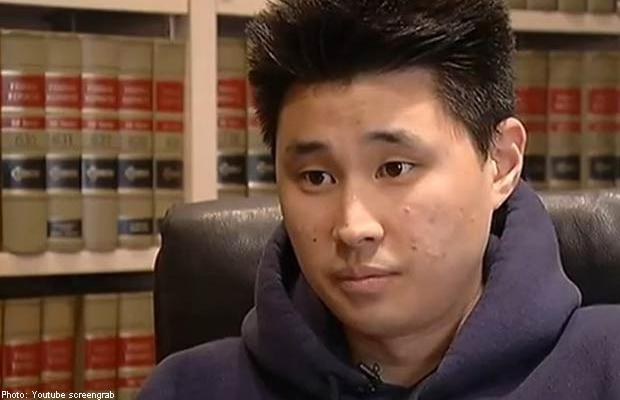
When 4/20 Goes Wrong: The Daniel Chong Story

by: Aaron Leaf

Daniel Chong Photo Credit: edvantage.com

Daniel Chong
Photo Credit: edvantage.com

2 years ago on April 20, 2012. 23 year old UCSD Student, Daniel Chong was celebrating the traditional cannabis friendly holiday “4/20” at a friends apartment in the University City neighborhood in San Diego. The following morning DEA (Drug Enforcement Administration) agents raided the apartment and seized marijuana, hallucinogenic mushrooms, and ecstasy pills. Chong and eight other people were transported to the DEA field office in the Kearny Mesa, where they were interrogated.

Seven of the nine detainees were then taken to county jail, one was released, and Chong was left in a holding cell at the DEA office, according to the DEA. Chong says he was told that he had been in the wrong place at the wrong time and that he would be released and even given a ride home. He was placed in a 5 by 10 feet holding cell, his wrists bound in handcuffs. He was then left in the windowless cell for five days despite repeated cries for help. He could hear people walking around outside the room but could not get their attention. At one point the lights went off for several days. While locked up, he was starving and hallucinating. He claimed that, while incarcerated, he had to drink his own urine for hydration, and ingested some methamphetamine that he found under a blanket inside the cell in order to keep himself awake. He attempted suicide by breaking one of the lenses in his eyeglasses, slitting his wrists with the shards and swallowing them. By the time he was discovered on April 25, he was hallucinating and completely incoherent.

Upon his discovery on April 25, Chong was taken to Sharp Memorial Hospital where he remained for five days, including three in the intensive care unit. He was treated for various problems including dehydration, near-failure of his kidneys, and a perforated lung from eating broken glass. He was never charged with any crime.

Attorneys for Chong filed a $20 million claim against the Drug Enforcement Administration, claiming that Chong’s treatment constitutes torture under the law and seeking damages for pain and suffering, future medical and psychiatric treatment, and loss of future earnings. On July 30, 2013 it was reported that Chong had settled his claim against the DEA for $4.1 million.

Nobody responsible for the incident has been disciplined, but the DEA has introduced national detention standards including daily inspections and cameras in cells.

Posted in Uncategorized | Leave a comment

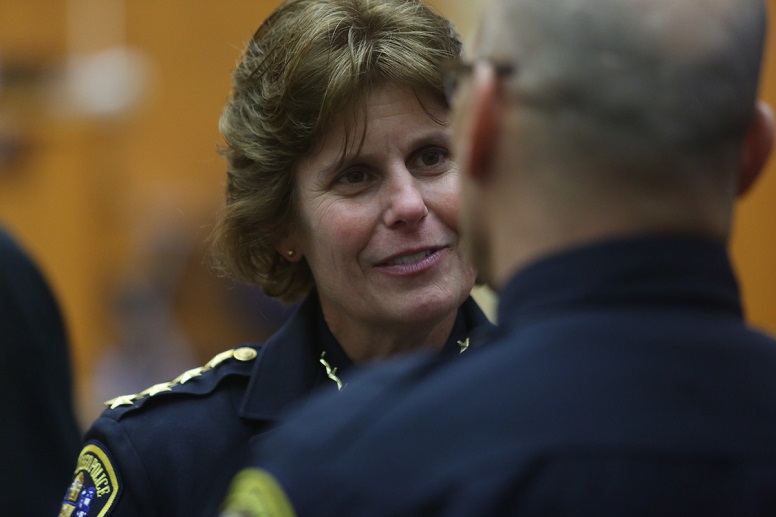
City settled lawsuit after Zimmerman & other officers were accused of ransacking home


Photo by Jamie Scott Lytle

Photo by Jamie Scott Lytle

In her 32 years in the department, Zimmerman has had just about every job you can think of. Undercover high school student. Bodyguard for the mayor. Internal Affairs. Vice. In the mid-1990s, she was working narcotics when she got into some controversy.

Zimmerman and four other SDPD cops went into a City Heights home after a tip about drug sales there. The Guatemalan family inside the house alleged in a federal lawsuit that the officers, in plainclothes, roughed them up, ransacked their house and threatened their 5-year-old daughter with a gun.

In a court filing, the city said Zimmerman and the other officers were serving a warrant after a confidential informant purchased cocaine from someone in the apartment. After the officers entered, they handcuffed the people inside, searched the home, found nothing and left within an hour.

“The only force used in serving the warrant was a show of firearms, including an automatic machine gun used by Officer Zimmerman,” according to the city’s filing.

The case settled and the family received $5,000. Zimmerman said she had only a vague recollection of the incident.

___________________________

Zimmerman also spent three months undercover in fall 1983 at Patrick Henry High in Del Cerro. Passing herself off as a Midwestern transfer named Shelley Rogoff, a 24-year-old Zimmerman infiltrated groups of students and targeted those she believed to be drug sellers. At the end, her work netted more than 70 arrests.

During court hearings, some of the students testified that while Zimmerman was acting undercover she smoked marijuana with the juveniles. Despite allegations from the students, Zimmerman told the court she didn’t use any pot, and the statements were disregarded.

original article by Voice of San Diego

Posted in Uncategorized | Leave a comment

United Against Police Terror’s Open Letter to Assembly Member regarding AB 2356

sb_rotate_2Assembly Member, Tom Ammiano
Chair, Public Safety Committee
1020 N Street (LOB), Room 111
Sacramento, California 95814
FAX (916) 319-3745

RE: AB 2356 (Gorell) Financing for adult local criminal justice facilities OPPOSE

Dear Assembly member Ammiano:

United Against Police Terror writes to inform you of our strong opposition to AB 2356, which would increase the bond funding for jail construction from $500,000,000 to $1.2 billion dollars. Not only would this be unsound policy, but the legislature has already allocated $500 million for jail construction via SB 1022, and $1.2 billion through AB 900.

UAPTSD works for systemic change in law enforcement agencies and advocating for victims of excessive force or police misconduct. We concentrate our efforts in the San Diego County and the collective’s work includes: informing people of their rights, lending support to victims of police terror by helping them file complaints in the police ethics system and dealing with wrongful accusations. We as an organization also denounce the harassment, violence, intimidation, arrests and abuse of power by police.

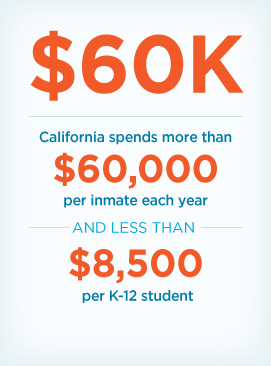
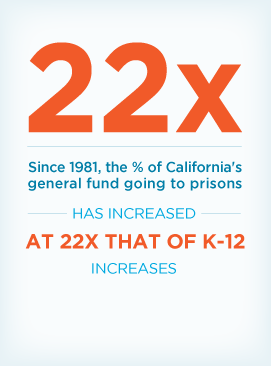
A new report by the Legislative Analyst’s Office (LAO) questions the need for any new jail construction funding. LAO recommends that proposals for new jail construction funding be put on hold until the state conducts an analysis of what space is needed and whether counties have “maximized alternatives to creating jail space.” Further, continuing to fund new jails de-incentivizes reducing the overcrowded jail and prison population. UAPTSD believes that the only sustainable solution to reducing the prison population is to lock up fewer people by reforming sentencing laws, preventing people from arrest and put funding and resources back into our communities. A majority of people behind bars are non-violent drug offenders who need transitional services, community-based treatment, housing, jobs and education so that they can successfully reintegrate back into society, where they belong.”

AB 2356 would allocate scarce public resources to jail construction. In an age when California has seen devastating cuts to education and health and human services, while increasing corrections spending, this is misguided public policy. Studies have shown that recidivism is reduced more by social services such as education, healthcare, and drug treatment programs than by incarceration. Additionally, funding social services versus jail can save counties thousands of dollars annually per person. Thus, all funding for jail construction should be immediately withdrawn, and instead these resources should go to community based services.

For these reasons, UAPTSD strongly urges you to vote no on the controversial AB 2356.


[1] LAO, February19, 2014 “The 2014-15 Budget: Governor’s Criminal Justice Proposals”

[2] Justice Policy Institute 2008 “Substance Abuse Treatment and Public Safety”

[3] Justice Policy Institute 2008 “Jailing Communities: The Impact of Jail Expansion and Effective Public Safety Strategies” 

CASJ-60k22x1in5


Posted in Uncategorized | Leave a comment

Statement Against The Expansion of Prisons for the Mentally Ill and Disabled

by Cathy Mendonca1534997_750535668342869_309167234_n
©uaptsd.org

In San Diego, community activists have been fighting against the proposals to a 792 bed facility expansion to Donovan State Prison for people with disabilities and mental health needs.

Imprisoning individuals with disabilities and who are mentally ill is not only a consequence of inadequate treatment and rehabilitation in the community but is also a result of the systemic prejudice these individuals in our society face.

Beginning in schools with the failure to develop and implement appropriate behavior plans or provide the necessary accommodations, discipline policies and punitive measures such as zero tolerance is often utilized in response to disability-related behavior, pushing students with disabilities out of the classroom and into the criminal justice system at alarming rates.

The same parallels can be drawn when examining how police and prison officials expect the same instant compliance to their commands. Police are often the first called to respond to medical psychiatric emergencies. If they do not receive compliance to their commands, they resort to a physical confrontation, often with brutal force.

For prison officials, failure to comply is often followed by discipline actions such as solitary confinement. Numerous studies have documented the effects of solitary confinement on prisoners and the devastating psychological and physical effects of prolonged confinement, causing prisoners significant mental harm and places them at grave risk of even more devastating future psychological harm.

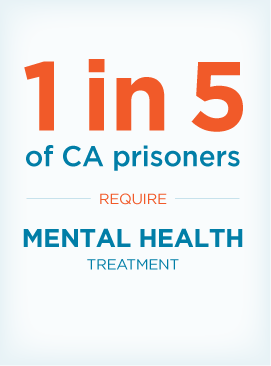
With suicide being the third leading cause of death in U.S. state and federal prisons, exceeded only by natural causes and AIDS, prisons are proven Ill-equipped to handle a prisoner’s current physical or mental condition and is a contributing factor to the digression of ones own mental health and physical well being..

Money should be allocated to programs promoting interdependence for the disabled and mentally ill to thrive within the community. It is not a crime to be physically disabled or to have a mental illness.

Prisons are not the answer to the treatment of these individuals.

Cathy Mendonca
United Against Terror San Diego and disabilities rights activist.

Prison Expansion Protest Flyer

Prison Expansion Protest Flyer


Sources

Posted in Uncategorized | Leave a comment

Justice for Shane Anthony Hayes

by: Aaron Leaf
©uaptsd.org

Shane Anthony Hayes

Shane Anthony Hayes

On September 17, 2006, San Diego County Sheriff’s Deputies Mike King and Sue Geer responded to a noise complaint at the Hayes residence. When they arrived, they were met outside by the girlfriend of Shane Hayes who told the deputies that Shane had attempted to harm himself in the past and was worried about him. Without question, or knowing of Shane’s past history of alcohol abuse and depression, deputies rushed in the house where they found Shane in the kitchen. One of the deputies ordered Hayes to show his hands for his right hand was behind his back. In a non threatening manner, Hayes took a step towards the deputies while raising both hands to shoulder level revealing a knife pointed tip down in his right hand. The deputies, who were standing about six to eight feet away from Hayes, drew their weapons and within “2 seconds” as deputies stated, immediately opened fire, hitting Hayes 3 times, killing him.

“Although Hayes was walking towards the deputies, he was not charging them, and had not been ordered to stop,” the court said. “He had committed no crime and had followed all orders from the deputies at the time he was shot.”

Shane’s daughter Chelsey , at only 13 years old, filed an action in federal district court, alleging claims under both state and federal law against the deputies, the county, and other jurisdictions. Chelsey alleged the deputies were negligent in failing to properly assess the situation before entering the house. She contended the deputies created the situation which led to Hayes’s death by confronting him without first determining, among other things; his level of intoxication, the potential need for non-lethal force to subdue him, or whether a Psychiatric Emergency Response Team (PERT) should be called in.

The district court granted summary judgment to all claims. Chelsey appealed.
The court of appeals pointed to what they saw as a lack of uniformity in California negligence law and certified to the California Supreme Court the following question: whether, under California law, sheriff’s deputies owe a duty of care to a suicidal person when preparing, approaching, and performing a welfare check on him.

The California Supreme Court granted the request for certification, holding that the deputies’ tactical conduct and decisions leading up to their use of deadly force had to be considered, as part of the totality of circumstances, in determining whether the use of deadly force was reasonable.

“The two San Diego County Sheriffs Deputies chose to end Shane’s life with deadly force and left the taser guns in the patrol cars only after a short time in the residence. Shane’s sober mind wanted to live, not die. He wanted to continue to be a father to his daughter, a son, uncle, and a brother. He needed help and the police were called for that reason, not to take his life. They didn’t give him a chance. We know he was not threatening anyone else but himself and never had threatened anyone else prior. He didn’t deserve to be shot at 5 times for being an alcoholic and being depressed. Shane needed help.” wrote Kristopher R. Hayes (Shane’s brother) in a letter sent to San Diego County Sheriff’s Department.

United Against Police Terror – San Diego condemns all acts of violence and the senseless killings of our family members and all members of the community by Law Enforcement. We demand that Deputies Mike King and Sue Geer and the San Diego Sheriffs Department be held accountable for their actions in the murder of Shane Anthony Hayes. We unite in support of the Hayes family in their quest for answers, and their fight for justice.

Appeal trial will begin July 2014 in San Diego. Check back here for updates.

SHANE HAYES FLYER

Posted in Uncategorized | Tagged , , , , , , , , , , | Leave a comment