


Follow Us on Social Media
COPWATCH EMERGENCY RESPONSE HOTLINE
Copwatch; 24hrs. 7 Days a week
For other requests, please contact uaptsd@gmail.com
Site Visits
- 384,559 hits
“Walking while brown and walking while black.” A call for pedestrian stop data, and the demand to end curfew sweeps
Continued discussion of Race from San Diego PD Releases Stop Data for 2014
Article from Reporting San Diego
BY NADINABBOTT on MARCH 15, 2015
Editorial by Cathy Mendonça, Community Leader
March 15, 2015 (San Diego) “Walking while brown and walking while black.” A call for pedestrian stop data, and the demand to end curfew sweeps
“These sweeps are not productive, and give police the right to detain children without cause and put them into the system.”
Curfew sweeps, a form of pedestrian stops, violate rights of parents/guardians to direct the upbringing of their children and violate youth’s 1st, 4th, 9th, and 14th amendment constitutional rights by; limiting their free speech and association and to move about freely, giving law enforcement excessive power to detain children while using unreasonable search and seizure, also by establishing a suspect classification based solely on the age of a group of individuals.
Regrettably to date, thousands of innocent youth have been arrested and detained during curfew sweeps, forced to pay large fees or attend a diversion program, for a fee. The overwhelming majority of youth, disproportionately youth of color, were committing no crime at the time of their arrest, consequently still pushing them into the prison systems. In San Diego, Latino and black youth make up 74% of the juvenile population in juvenile facilities. Furthermore, there is no evidence that curfews lower crime levels, reduce youth crime or lower rates of juvenile violent death than jurisdictions without curfews.
In a report published in June of 2012 by voice of san diego, police have funneled more resources toward enforcing the city’s 10 p.m. curfew on kids. it was found in these sweep operations, conducted in the City Heights, southeastern and downtown areas, after months of investigation, some of the biggest claims about their effectiveness and implementation are questionable or unfounded. Examining the data, most juvenile crime in San Diego actually happens outside of curfew hours.
Contrary to proponents’ claims, the number of juvenile arrests have typically peaked around 10 a.m. and the number of juvenile victims of violent crime around 3 p.m. After those peaks, crime has tended to gradually fall until the early morning hours.
158 people have signed on to the petition submitted to Myrtle Cole, Todd Gloria, Marti Emerald, Chris Cate and to all City Council members to see an end to this activity. To this date, there has been no response from City Council in regard to this demand.
Sign the petition San Diego City Council: Stop Curfew Sweeps in San Diego, California
in the prior article A Discussion of Race at City Hall, San Diego PD Releases Stop Data for 2014
According to Chief Zimmerman this contact data is not collected. The chief was pressed by committee members and was instructed that perhaps it is time the department also gathers this data, including data from Metropolitan Transit System sweeps.
Catherine Mendonca is a City Heights Community Leader, Her views are her’s and do not necessarily reflect those of Reporting San Diego. We invite editorials from the Community.
Posted in Uncategorized
Leave a comment
SDPD policies allowed misconduct to go undetected for years, report finds Via FOX 5
POSTED 11:40 AM, MARCH 17, 2015, BY FOX 5 DIGITAL TEAM, UPDATED AT 12:25PM, MARCH 17, 2015
Full Article here
SAN DIEGO — A U.S. Justice Department probe into officer misconduct at the San Diego Police Department found gaps in policies on officer misconduct, a lack of consistent supervision and a failure to hold employees accountable.
Ron Davis, director of the federal Office of Community Oriented Policing Services, said the latter problem allowed officer misconduct to occur and go undetected for years.
Report: Findings of Assessment of San Diego Police Department
Davis said the investigation focused on 17 cases of misconduct.
“On one hand, we found that the 17 cases were not linked to any particular behavior or one item, but we did find some areas that are definitely in need of improvement, or deficiencies,” Davis said at a news conference today to announce the findings.
“I think the thing that stood out for us was the failure of leadership on small issues,” Davis said. “Like anything else, failure on small issues leads to big issues.”
Davis, whose report includes 40 recommendations, and U.S. Attorney Laura Duffy said the SDPD has already implemented some corrective measures.
Mayor Kevin Faulconer, City Attorney Jan Goldsmith and SDPD Chiefs Shelley Zimmerman and her predecessor, William Lansdowne, asked for the probe about a year ago, following a series of arrests of officers for various violations.
Among them:
- Anthony Arevalos was convicted of demanding sexual favors from women stopped for suspected drunken driving in the Gaslamp Quarter;
- Christopher Hays pleaded guilty to groping and illegally detaining four women while on duty; and
- husband-and-wife officers Bryce and Jennifer Charpentier admitted to breaking into people’s homes to steal prescription painkillers to feed their drug habits.
- Other officers were arrested for drunken driving, domestic assault and indecent exposure.
City leaders asked for the federal investigation and for recommendations to improve local policing and public safety efforts with the goal of restoring public confidence in the SDPD.
“This is a report that I welcome as mayor of the city of San Diego,” Faulconer said. “The good news for San Diegans is that this department is making significant progress on virtually every single one of these items.”
He said when he became mayor, it was critical to restore confidence in both the city government and its police department, the reputation of which was sullied by a small number of people.
All San Diegans are invited to look at the report, he said.
CRITICAL RESPONSE TECHNICAL ASSESSMENT REVIEW Police Accountability—Findings and National Implications of an Assessment of the San Diego Police Department
Posted in Uncategorized
Leave a comment
San Diego Calls for a true Community Review Board on Police Practices
A Coalition of the Black Student Justice Coalition, Women Occupy San Diego and United Against Police Terror has prepared this online petition to reform the San Diego Citizens Review Board on Police Practices. We have a real chance of getting an Independant Community Review Board with subpoena powers. SHARE SHARE SHARE
“Abuse of power by SDPD takes many forms, from endless citations, questioning, searches and seizures, sexual harassment, physical abuse, wrongful arrest to police shootings. More than 200 cases of individuals killed by law enforcement have been documented. Rarely are the lives or names publicized. The tools to hold SDPD accountable are not working. Currently we suffer from a crisis of trust.”
“Our organization is endorsing a call to reform the Citizens Review Board on Police Practices (CRB). We call on the Charter Review Committee to reference the model of the San Diego County Law Enforcement Review Board, empowered by the voters in 1990 by passing Proposition A. (http://www.sandiegocounty.gov/content/dam/sdc/clerb/brochure09.pdf)
City Charter reforms essential to the effective functioning of civilian and community oversight of the SDPD include:
- Independent investigators and subpoena power, as provided to the San Diego County Law Enforcement Review Board by the voters in 1990 (Proposition A).
- Intake, tracking and review of all complaints filed is done by the CRB rather than by SDPD Internal Affairs, also as modeled by the San Diego County Law Enforcement Review Board approved by the voters in 1990.
More Info
Mark Jones, BlackStudentJusticeCoalition@gmail.com
Stephanie Jennings, WOSD: stjennings@ucsd.edu
Cathy Mendonca, UAPTSD: uaptsd@gmail.com
Families need your help in Justice for Victor Ortega and All SD Stolen Lives
As many of you know, on June 4, 2012, 31 year old, Victor Ortega was executed by San Diego Police Officer Jonathan McCarthy. According to witnesses Victor was lying on the ground and in compliance with the officers’ demands.
As many of you also know, Uaptsd.org’s mission is to keep alive the county list of recorded people killed by law enforcement agents from 1980 to the present. Through grassroots efforts, over 200 local cases were documented. https://uaptsd.org/victims/victims-murdered-by-sd-law-enforcement/. Recently, we have received increased intimidation by police during these rallies. Many, if not all of these actions, involve families like the Ortega’s who have young children and, like Victor himself, did not and do not pose a threat to police or to public safety. Police intimidation is a tactic to silence families and anyone who speaks up against these injustices. We are calling on our community for united support in these actions for these families cannot and should not be harassed when speaking the truth about the death of their loved ones. Like Ferguson’s fight for justice for Mike Brown, our duty is to fight for San Diego’s stolen lives murdered by those who supposedly “protect and serve” our community.
More on the Ortega Story
Initially, McCarthy claimed he shot Victor because his back-up gun fell from its holster and Victor reached for it. He later claimed he shot Victor because he was “too tired to continue with the arrest”. A witness heard the officer shouting “Get on the ground!” at Victor and Victor responding, “Are you kidding me?” right before he was shot. Victor was already on the ground face down with both arms cuffed before he was shot, a police lieutenant later admitted.
The Ortega family filed a federal lawsuit claiming Ortega’s civil rights were violated, and that the officer had no reason to pull the trigger.
U.S. District Judge has recently noted inconsistencies in some of the statements made by McCarthy, who claimed Victor tried to take away his service weapon. There is a further inconsistency around Officer McCarthy’s use of a non-lethal Taser and the facts leading up to the struggle between McCarthy and Ortega. Victor Ortega was a loving father, husband, son, grandson,brother, nephew, cousin, and friend to many.
Recent Article via Reporting San Diego on March 14 Action
“Michelle Ortega then took the bullhorn. While Shakina lost a husband, she lost a brother. Michelle said that ‘this police brutality thing is a world wide thing. My goal is to get Victor’s name out there, and get the awareness, and get Jonathan McCarthy (the officer) to go to jail, which he will eventually.’ She, like Shakina, added ‘it means a lot when you guys come out, especially on a hot day like this.’ (The temperature was hovering around 90.) According to Michelle, ‘this is actually putting pressure on them, even though it might be 20 or 30 people out here. It does really make a difference.’ She was emphatic,‘they don’t want us out here. Every time we come out here just for Victor Ortega, they are mad about that. They don’t want the media, they don’t want the attention of the community to know what they really did.’ At one point the sister of Victor Ortega got on her knees in front of the officers protecting the sign. She put her hands behind her back, and told them to arrest her and shoot her. That way her mother could lose another child. The officers did their level best to ignore it and looked everywhere but at her.”
“She also asked them if any of them was a good cop? She asked them to stand up and denounce the bad officers in the department. Officers just stood there.”
Family of Victor Ortega Speak Out at SD Stolen Lives Rally https://youtu.be/d19ax_Ifc3Q
Public Comment on San Diego Stolen Lives Killed by LEO at City Council Meeting https://www.youtube.com/watch?v=qNzh82Pf7lw
These rallies are held once a month in City Heights. for more information, please contact us at uaptsd@gmail.com, visit our website uaptsd.org or our like page United Against Police Terror
We thank you in advance for your help and support.
Posted in Uncategorized
Leave a comment
Systemic Racial Inequality Within The Justice System
-
Our legal system was designed to promote fairness and work for justice. However, people of color, especially black men, are arrested and tried at higher rates than whites. Once they are arrested, blacks are disproportionately more likely to go to jail for the same crime whites commit. According to the Pew Research Center
 , blacks were “more than six times as likely as white men in 2010 to be incarcerated in federal and state prisons, and local jails.” In addition, “five times as many whites are using drugs as African-Americans, yet African-Americans are sent to prison for drug offenses at 10 times the rate of whites .”
Here is a look at systemic issues social workers may need to be more aware of in order to challenge them head-on.

 Found on Huffington Post , based on an FBI Report
 The American Conservative , based on a U.S. Department of Justice study
 The American Conservative , based on a U.S. Department of Justice study
Created by USC’s online masters in social work program
March 5th, 2015 by Gabriela Acosta USC Social Work
Posted in Uncategorized
Leave a comment
February 22, 1974 – The Day Ocean Beach Became an Armed Police State
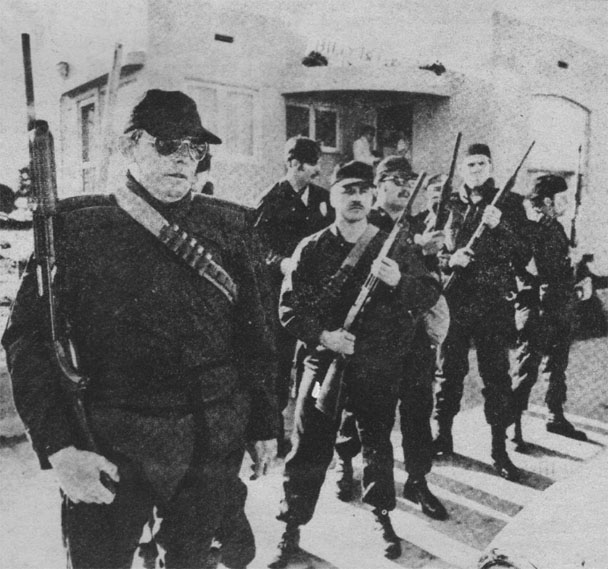
Police Swat Team on Abbott Street, 1974.
OCEAN BEACH, CA. 42 years ago, on February 22, 1974 – all hell broke loose in Ocean Beach – and for many of the seventies generation, this day will always live on in their memory as a day of infamy – the day the world came crashing down on our little seaside community. It was the day that Pete Mahone, a politicized ex-convict and member of OB’s anti-Vietnam war community, tried to commit suicide by cop. It was also the breaking point in police-community relations, relations that had been simmering for years.
On February 22, 1974, Pete calmly walked up to San Diego police officer William Ritter who was sitting in his car while parked in the OB Pier parking lot, pulled out a hand gun and opened fire once through the window in the direction of the officer. A soon as he had made his shot, Pete calmly walked back to his little beach shack along Abbot Street and waited. He knew what was to come.
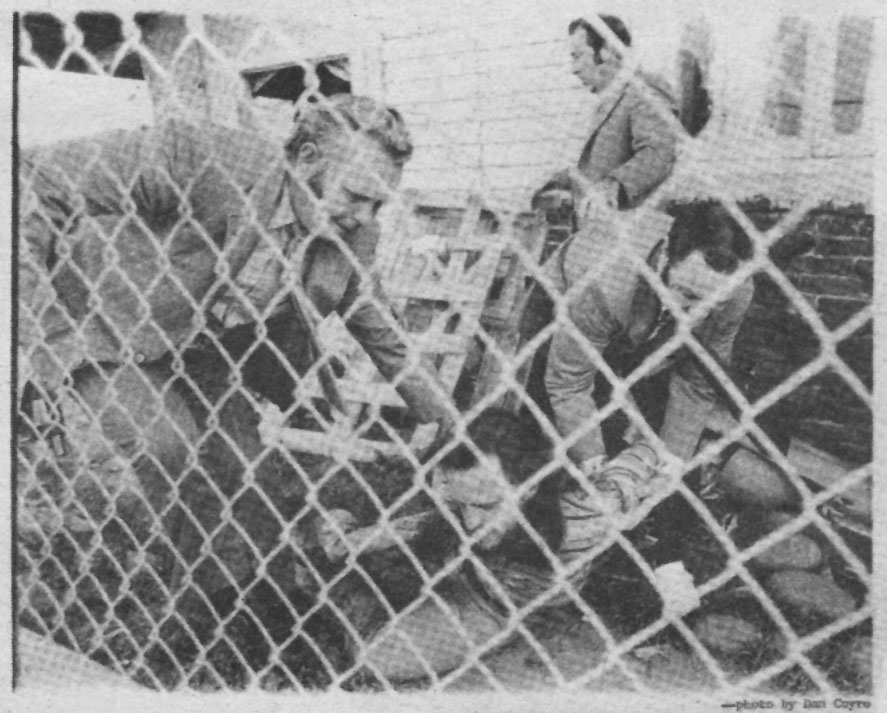
SDPD subdue and arrest Peter Mahone in the front of his Abbott Street cottage, Feb. 22, 1974.
Fortunately and miraculously, the officer -at the moment the gun went off – had turned his head and had opened his mouth. The bullet entered his mouth, chipped a tooth and exited through the back of his neck. Ending up only with a flesh wound, Officer Ritter was well on his way to recovery a month later.
As he waited in his little cottage on the 2000 block of Abbott, Peter Mahone anticipated that the cops would come rushing through his door. Over the course of the next few hours, police officers did that, but much, much more.
Ocean Beach quickly became an armed police state.
Once the call had gone out that an officer was down in Ocean Beach, things exploded. Here’s how the OB Rag reported it, in an article entitled, “OB UNDER SIEGE”:
… police units from all over San Diego converged on Ocean Beach. Suddenly the community was under siege. A command post was set up at Robb Field, a helicopter from the county Sheriff’s department was called in, and uniformed and plain-clothes police officers began detaining and questioning people.
Incidents of violence have not been uncommon, in Ocean Beach. But rarely has a police officer been a victim. This time, according to many of the literally hundreds of people who experienced and observed the events of the day, the cops rushing into Ocean Beach were “out for blood.”
Many violent acts took place last Friday. Folks in the neighborhood of Abbott and Saratoga woke up to pistols being pointed at their heads by police officers. Many residents were held indiscriminately at gunpoint as they were frisked and forced to identify themselves. Four persons who watched the police actions were arrested and one of them was later beaten by police…
In one incident, officers attempted to enter a residence at 2014-1/2 Abbott Street. At some point shots were fired. Detective Michael De Bruler was injured. The Abbott Street residence was surrounded by police. According to neighbors and witnesses, police then opened fire without warning to whatever occupants might have been inside and without giving a chance for anyone to surrender.
Many volleys of shots were fired and tear gas was thrown into the house. One suspect, Peter Mahone, emerged from the house with his hands raised. He was hit by a plainclothes officer in the back of the head with the butt of a gun which allegedly discharged at that time. Mahone apparently suffered one wound in the shooting. He was removed from the scene by police.
For the entire article (“OB UNDER SIEGE”)
Throughout the takeover of Ocean Beach by police that day, numerous people had been harassed and arrested, as the Rag recounted. All 4 arrests of bystanders were thrown-out. Two of those arrested had been activists and friends of Peter Mahone.
PETER MAHONE

Drawing of Peter Mahone by Diana Tuminia, Ocean Beach 1974.
Peter Mahone somehow survived. Officer Ritter survived. Detective De Bruler, wounded by friendly fire, survived. But did the community? The history of this day is an important day in OB’s history, because it brought the community together, the tensions between police and the community came to a head – and led to their resolution months later, as importantly, this day ignited a community-wide campaign for police reform.
Peter Mahone was charged with 5 counts of attempted murder, 5 counts of assault with a deadly weapon, and possession of a gun while on parole, and his bail was set at $200,000 – which 35 years ago, was a lot of money. After the shootout and the turmoil that followed, Peter became somewhat of a cause celebre within the activist community.
While no one condoned what he did, friends and fellow activists strove to understand what made him do it. A Defense Committee was set up immediately, which aided him in obtaining legal representation and covering some of his legal costs.
Older than most of the other OB anti-war and community activists, Peter had been institutionalized for much of his life, for petty crimes and burglaries. During his later days in prison, he had become politicized – like many inmates had during the heady days of the late sixties and early seventies. He got out of prison in the early 1970s and on parole. He had enrolled in a college program at San Diego State for ex-cons. At State, he met radical professor Peter Bohmer and other activists – many of whom lived in OB, as OB provided a veritable safe haven for radical, anti-war and hippie ways and politics . So Mahone moved to the beach and became active in the movement to stop the Vietnam war.
In the Spring of 1972, during a particularly horrible intensification of the war by President Nixon, the anti-war movement all over the country intensified its efforts to bring the military conflict to an end with more and more militant tactics. Anti-war demonstrators had blocked traffic on I-5 in downtown San Diego. Activists rallied and burned trash cans along Newport Avenue. Protests occurred across the country.
Up in North County, right outside Del Mar, an anti-war rally was held. Protesters had built a pile of timber on the railroad tracks that run along the Pacific Ocean and lit it in an effort to block a train carrying war munitions to San Diego to be shipped to Vietnam. Police arrived in force, and arrested a number of people, including Peter Mahone, and his mentor Professor Peter Bohmer, along with another well-known OB community activist. In all, 3 Ocean Beach residents were arrested at this protest, and included in what was later called “the Del Mar 4″. (People v. Bohmer Court Documents)
Months later, during the preparation for the defense of the Del Mar 4, it was discovered that police informants had infiltrated the defense team – a clear violation of the Fifth and Sixth Amendment rights. When lawyers for the defendants tried to have the charges thrown out due to this usurpation of civility, the judge ruled against the activists.
Peter Mahone never quite got over this legal defeat. This arrest brought him other police harassment back in OB. In time, he started taking hard drugs and becoming very paranoid and delusional. Fellow activists who were his roommates became uneasy with his behavior, and watched him become unstable.
About a month before the February shootout, his roommates had asked him to leave. They couldn’t handle his paranoid and strangeness. One roommate had come home to find the telephone busted up and in the trash. Another day, a paper-cutter had been destroyed, and Peter saved the handle to protect himself.
Mahone finally went to trial and was convicted of some of the charges. A number of friends had testified at his trial to his instability leading up to the shooting. Nevertheless, he ended up back in prison for some ten or so years. Out of prison once again, he lived in the Bay Area. It is believed that Peter died in 1993.
So ended the Peter Mahone saga. But the community of Ocean Beach was changed forever by what he did on February 22, 1974.
LEARN MORE ABOUT POLICE-OB RELATIONS IN THE 1970’S
Ocean Beach in the 1970s – How an armed police camp led to reforms in police practices
Original Article by Frank Gormlie OB Rag Feb 22, 2010
Posted in Uncategorized
Tagged abbott st, brutality, ob rag, ocean beach, OIS, police state, police terror, San Diego, San Diego Police Department, sdpd
Leave a comment
City Heights Business Owners Brutalized by San Diego Police

Hedy Julca was arrested inside her store while her 3-year-old son watched from close by. Her son Diego Lobaton, right, was detained by officers outside the store.
Last July, Luis and Diego Lobaton were returning to their family’s store in City Heights after sneaking a late-night cigarette. They expected a rebuke from their mother.
A mother’s upbraiding turned out to be the least of their worries.
As the brothers, along with Luis’ girlfriend, walked back to the store from up the street, they were followed by two San Diego police officers. Four more officers soon joined the scene. In a brief but violent encounter, Diego was handcuffed and detained as he opened the door to the store, and Luis was punched repeatedly by an officer who barreled inside with other cops and arrested him.
Hedy Julca, the Lobatons’ mother and the owner of the store, tried to get between two officers who were pounding on Luis Lobaton. An officer wrestled her to the floor. She, too, was handcuffed and arrested as another son, 3-year-old Bruce, watched from close by.
There was no 911 call, no worried neighbors who drew the officers there that night. Police on patrol simply watched the brothers separately take out keys and enter the store, and decided something nefarious was in the works. The whole thing went down because of a suspected burglary in the brothers’ own home.
Things got worse for Luis Lobaton and Julca before they got better: They were both placed on immigration holds while in custody, though Lobaton is a U.S. citizen. He was held for three days as family members scrambled to find his birth certificate to prove his citizenship. (Julca is a Peruvian citizen and is in the country illegally.)
The July 29, 2014, scuffle was over in about a minute. But its impact has been long-lasting for the family: Julca and the toddler are in therapy, Julca said. Luis Lobaton said he has suffered from memory loss and neck pain.
Police spokesman Lt. Kevin Mayer confirmed the department is conducting an internal affairs investigation over the incident, but declined further comment.
Attorney Randall Hamud filed a claim for unspecified damages on behalf of the family on Jan. 14. A claim is usually a precursor to a lawsuit.
The Police Department has faced numerous charges of officer misconduct in recent years, and a federal review of the department’s misconduct policies is due later this month. Police Chief Shelley Zimmerman has instituted reforms aimed at cracking down on misconduct, including outfitting officers with body cameras. The family says that the officers weren’t wearing them the night of the incident; SDPD would not confirm whether any of the officers were wearing them or not.
The family’s business, Lucky Star Mobile, is located next to an alley on a stretch of University Avenue lined with small businesses whose owners represent a melting pot from across the globe.

The family doesn’t just run the store, they live there too – the back of the store is a living quarters. Luis and Diego Lobaton were living there at the time. Julca and the others, including the toddler’s father, were home that night, watching television in the retail area before officers arrived.
A report filed by Officer Kelvin Lujan said that he and his partner, Officer Sam Euler, were patrolling the 4600 block of University Avenue when they saw Luis Lobaton, 21, and his girlfriend, Emily Fajardo, 18, strolling on the sidewalk. It was about 10:30 p.m. and the pair raised the cops’ suspicion, though the report doesn’t say why. Their suspicion was fueled further when Lobaton unlocked the front door to the store, which was closed, and the couple went inside.
The police reports say officers sensed that Lobaton and Fajardo were engaged in a commercial burglary.
According to Lujan’s report, he was standing outside the store, suspecting that a burglary was in progress, when Diego Lobaton, 20, walked up and in front of the cop “attempted to enter the business.” Lujan acknowledged that Diego Lobaton said it was his brother who had walked inside.
The version of what happened next that is spelled out in officers’ reports and the version told by members of the family differ wildly. But several surveillance cameras inside and outside the store captured the incident and appear to largely back the family’s version of events.
Some of the significant points of contention between police and the family:
• One officer says in a report that Diego Lobaton, who had a key to the store in hand, “attempted to lock the door” to prevent police from going inside. The surveillance video shows otherwise.
On the video, a copy of which was provided to Voice of San Diego along with police reports by the family through their attorney, Diego Lobaton is seen arriving at the store less than a minute behind his brother. Lujan, the officer, walks into the picture and begins talking to him as he unlocks the door. Diego Lobaton pulls the door open, and Lujan nudges him away. At about the same time, Julca’s 3-year-old son is seen on video inside the store, running to the opened door. (The child can be seen on the second video below, from about on 7:28 to 7:58 on the video player, or from about 10:28:53 to 10:29:40 according to the clock at the top of the screen.) The boy is not mentioned in any of the reports.
Officer Michael Usrey says that at one point Julca “grabbed [the door] and pulled it shut” while Lujan was trying to talk to Luis Lobaton inside. The video doesn’t appear to show Julca holding the door shut, though she may have closed it at some point. But the video does make it clear once Julca opened the door to speak with Lujan, another officer held it open until the cops rushed inside.
• Each report says that the officers were not told that the family owned the store until after arrests were made. One even says that Luis Lobaton “now understands why [officers] were there and was appreciative they were looking out for his mom’s store.”
The family, of course, disputes that.
“I told [Lujan], ‘This is my business.’ I told him Diego had a key to the store. How could he be robbing the store? I told him Diego and Luis are my sons,” Julca said.
“You’ve got several cops standing by the door telling the family, through an open door, that they believe they are burglarizing their own store and nobody told them, ‘Wait a minute, officers. This is our store’? Who’s going to believe that?” said Hamud, the family’s attorney.
Three officers say in their reports that Luis Lobaton assumed a boxer’s or fighter’s stance. Lujan writes that he believed “Lobaton was now in a position to cause bodily harm and or injury to me.”
Luis Lobaton swung at him twice trying unsuccessfully to hit him in the face, said Lujan.
The video shows that Luis Lobaton was inside the store, with his mother standing in front of him, and officers outside on the sidewalk. Luis Lobaton’s left arm is extended, and he’s holding an object with a light, presumably a cell phone, in front of his face. Lobaton said he was attempting to record the interaction on his phone. Lobaton does not appear to swing or lunge at the officers in the video and actually appears to be backpedaling when an officer rushes inside and begins striking him. (Jump to about 7:50 on the video player, or 10:29:31 on the surveillance video clock.)
Beyond videos casting doubt on officers’ accounts of any aggressive actions by Luis Lobaton, there’s another reason the police version doesn’t make much sense: Luis Lobaton said he has had a brain tumor since he was a child and getting in a fistfight with a cop, or any situation that might invite blows to his head, was the last thing he wanted to do that night.
Julca said her son had to stop playing sports because of the tumor.
“I was afraid for Luis when I saw the officers punching him in the head,” she said. “I was afraid they were going to kill him. I wanted to pull them away.”
• One report says Diego Lobaton told officers that his brother Luis was a gang member.
“They were trying to make me admit that he is in a gang, and they were trying to make me say that I understood why they thought Luis was a burglar. I told them that I couldn’t understand why they roughhoused my brother and why they yanked my hands up behind my back. That hurt,” Diego Lobaton said.
♦ ♦ ♦
Luis Lobaton and Julca were charged with assaulting an officer and resisting arrest, but those charges were dismissed.
After she was driven to the police station, Julca said she was kept handcuffed in the back of a patrol car for about 40 minutes.
“Some of the officers who had been at the store were standing outside and laughing. I heard one of them say to the others, ‘What are we going to put in the report?’“ Julca said.
Although the charges against Julca were dropped, her legal problems are not over. Julca, a Peruvian citizen, is facing possible deportation. She is in the country illegally and returned after agreeing to a voluntary removal when apprehended about 10 years ago. She was turned over to U.S. Department of Homeland Security officers after her release from Las Colinas Detention Facility and has hired an immigration attorney.
Luis Lobaton posted bail but had to spend a few extra days in jail because the staff forced him to prove he is a U.S. citizen. A sister had to obtain his birth certificate from the county. His citizenship was not an issue on Lujan’s arrest report. The officer marked “N” indicating No in the box that asked if Lobaton was an “undocumented person.”
Luis Lobaton, tattooed and wiry, is no stranger to the criminal justice system.
He is awaiting a preliminary hearing in February for a 2012 burglary charge and is free on bail. He said he’s had contacts with police since he was a juvenile, and at one point belonged to a Clairemont tagging crew.
In October, he pleaded guilty to a misdemeanor count of resisting a police officer in an incident stemming from an argument with his girlfriend. Authorities said he was belligerent and aggressive with the officer. A more serious charge of using physical force on an officer, a potential felony, was dismissed in exchange for his guilty plea to the misdemeanor count. He received probation and a fine.
On July 28, the day before the incident at the family’s store, two officers detained him at the El Cajon Boulevard tire shop where he works. He was handcuffed, questioned and detained in a patrol car but released at the scene. In a cell phone video recorded by a witness, an officer said Lobaton matched the description of a suspect they were looking for. Almost five months after the July incident at Lucky Star Mobile, police returned to the store on Christmas Eve. Five officers again followed Luis Lobaton inside. Julca said they told her he was acting suspicious.
SDPD said it would look into this incident, after an inquiry by Voice of San Diego.
Fortunately, though, the December encounter between Luis Lobaton and police was peaceful.
He was questioned but not arrested.
♦ ♦ ♦
Original Article by H.G. Reza – Voice of San Diego February 9, 2015
Posted in Uncategorized
Tagged brutality, city heights, harassment, mid city, police officer, police terror, San Diego, San Diego Police
Leave a comment
San Diego’s #ReclaimMLK #4MILEMARCH PRESS RELEASE
FOR IMMEDIATE RELEASE
 Monday, January 19, 2015 San Diego, Ca – Please join United Against Police Terror – San Diego, Activist San Diego, San Diego Branch of the ISO and Coalition Against Police Violence, San Diego’s #4MILEMARCH. The 4 Mile March will take place on Martin Luther King, Jr. Day and the rally will start at 1:00pm at the City Heights/Weingart Library and Performance Annex 3795 Fairmount Ave, San Diego, California 92105 ending at Malcolm X Library at 5148 Market Street, San Diego, CA 92114……….. Facebook event Page, Ferguson Action Page
About San Diego’s #4MILEMARCH
Activists and community members in San Diego have answered the national call put out by the Coalition Against Police Violence (CAPV). The mission of the 4 Mile March is two-fold: to bring awareness to America’s epidemic of racial profiling and police brutality, and to honor all those who have been injured or died as a result of police violence. One of the most important steps we can take is to build mounting pressure upon our local and federal government to do what is right. Elected officials must mandate laws that will hold police accountable for every illegal and inhumane act they commit against the human rights of Black citizens, the mentally ill and those of lower socio economic status. We will march because “it is our duty to fight for our freedom; it is our duty to win.”
Why march on this day?
 There is no question that Martin Luther King, Jr. stood for justice and equality. We believe that he would fight for police reform and the right for fair treatment of all human beings if he were alive today. By marching on his Observance Day, we seek to both honor the legacy of Dr. King, and to remind the nation that the fight for justice and equality is far from over!
In ever increasing numbers, unarmed men, women and children are shot to death, beaten and wrongfully treated by police. Whether it is because of the perception of fear of a certain ethnicity, their socioeconomic status, or because of mis-communication between police and civilians—police accountability is absolutely necessary for prevention and law enforcement reform.
How will the march take place?
Each person will march in remembrance of the #SDSTOLENLIVES killed by every branch of SD Law Enforcement to put pressure on local and federal government.
Can’t attend a 4 Mile March event on MLK Day?
Things you can do to show solidarity: Call your local media to remind them about 4MM to bring attention to those that are out in the streets. Use the hashtag #4MILEMARCHSD #CAPV #UAPTSD #ASD #SDSOCIALISTCAMPAIGN #RECLAIMMLK #RECLAIMTHEDREAM #SDSTOLENLIVES on Twitter, Facebook, Instagram to spread news about what’s happening on Monday. Another is hold a photo of someone killed by police and post on social media with #4milemarch #(Name of victim)
Contact
To learn more about this event, please contact
Cathy Mendonca, United Against Police Terror
Office: (401) 580-7791
Posted in Uncategorized
Tagged black lives matter, brutality, county, federal charges, ferguson, grand jury, killer cops, martin luther king jr, murder, oppression, police, San Diego, San Diego Police, terror, uaptsd
Leave a comment