Police use face scans in the field | UTSanDiego.com Mobile

http://m.utsandiego.com/news/2013/nov/08/cir-facial-recognition-software-san-diego/
“Story by Ali Winston & Allison Sampite-Montecalvo

Facial recognition software common in the military is finding its way to local police departments, and agencies across San Diego County are at the forefront of deploying the technology on their tablets and smartphones.

Law enforcement officials praise the program as effective for identifying criminals, but some civil libertarians see growing databases of such information as a threat to privacy.

The Tactical Identification System, coordinated by the San Diego Association of Governments, matches images taken by officers in the field with databases of about 348,000 San Diego County arrestees. The system itself has nearly 1.4 million booking photos because many people have multiple mug shots on record.

Commander David Myers with the San Diego County Sheriff’s Department said deputies have used the technology for the last six months to a year in various circumstances, including during traffic stops when a person cannot produce legitimate identification or any at all.”

Posted in Uncategorized | Leave a comment

Watch “SAN DIEGO POLICE DEPARTMENT: POLICE POWER & A CULTURE OF CORRUPTION” on YouTube

Posted in Uncategorized | Leave a comment

With harsher disciplinary measures, school systems fail black kids The Edvocate | The Edvocate

http://www.theedadvocate.org/with-harsher-disciplinary-measures-school-systems-fail-black-kids/
” *The Edvocate is pleased to publish guest posts as way to fuel important conversations surrounding P-20 education in America. The opinions contained within guest posts are those of the authors and do not necessarily reflect the official opinion of The Edvocate or Dr. Matthew Lynch.**

Esther Canty-Barnes, Rutgers University Newark

Although it has been over 60 years since the Brown v Board of Education decision, black students are still more likely to receive out-of-school suspensions for minor violations of the code of conduct. As a result, they are more likely to drop out of school or enter the juvenile justice system.

Black students constituted 32%-42% of those suspended during the 2011-12 school year, even though they represented 16% of the student population.

As racial tensions resurface in the aftermath of the conflicts and riots in Ferguson and Baltimore, we need to consider whether some of these issues have their origins in the manner in which children of color are treated in our schools.

As a clinical professor of law at the Rutgers University Law School’s Education and Health Law Clinic, I provide legal representation to parents and their children in cases where they are being denied an appropriate education or are suspended from school.

This includes filing legal complaints, attending meetings and assessing the appropriateness of a student’s educational program. At the clinic, my colleagues and I have seen firsthand the disparities in the treatment and resources provided by schools. And often, I have seen that suspension of young black students begins as early as kindergarten.

Educational inequities for black kids

Our educational system continues to fail children of color.

Research shows that black males are disproportionately more likely to be placed in special education and classified as mentally retarded and emotionally disturbed.

They are also more likely to be placed in segregated placements, more likely to be educated in poorly performing schools and more likely to be referred to the juvenile justice system for infractions that occur in school.

They are also the least likely to be provided the positive supports and the assistance that they need in order to succeed.

None of this is new.

Children of color have historically been subjected to educational inequities. After the landmark decision of Brown v Board of Education in 1954, where the Supreme Court held that it was unconstitutional to maintain segregated schools, practices and policies were developed to maintain segregated settings.

States in the South refused to comply with Brown, while other parts of the country developed practices such as IQ testing and tracking students into specific programs that often kept children of color in different classes from their white counterparts.

The Children’s Defense Fund (CDF), headed by Marian Wright Edelman, was one of the first organizations to look at the disparities in access to education. In its groundbreaking report in 1975, “School Suspensions: Are They Helping Children?,” the CDF analyzed the reports submitted to the Office of Civil Rights.

Although black students accounted for 27.1% of the students enrolled in the school districts reporting to the Office of Civil Rights in the 1972-73 school year, the report found that they made up 42.3% of the racially identified suspensions.

At the high school level, black students were suspended at more than three times the rate of white students: 12.5% versus 4.1%.

Persistent patterns of suspensions

These inequities in suspensions and removal from school continue to persist.

In recent times, the term “school-to-prison pipeline” is often used to describe systemic practices that ultimately lead students of color into the criminal justice system. These policies often cause the suspension or removal and sometimes the arrest of students from school for nonviolent or minor violations.”

Posted in Uncategorized | Leave a comment

Via MIC ; These Are the People We Ignore When We Talk About Black Lives Lost to Police Brutality

http://m.mic.com/articles/118932/how-activists-are-making-sure-we-remember-black-women-and-girls?fb_action_ids=10153236669930791&fb_action_types=og.shares

These Are the People We Ignore When We Talk About Black Lives Lost to Police Brutality

“The reality is, when black, straight, cisgender men and boys are beaten, brutalized and/or murdered by the police or white supremacists, it becomes a national issue in the black community, and in a few instances … the outrage moves beyond the black community,” Aishah Shahidah Simmons, producer and director of No! The Rape Documentary, told Mic. “Today’s actions are necessary and important interventions because they disrupt this narrative that violence against black cis and trans women are not also worthy of mass mobilization, protests and demands for accountability.”

Posted in Uncategorized | Leave a comment

25 Shocking Facts About the Epidemic of Police Brutality in America | TruthVoice

http://truthvoice.com/2015/06/25-shocking-facts-about-the-epidemic-of-police-brutality-in-america/

“The recent unveiling of the Counted, a tracking system designed by the Guardian to count the number of civilians killed by police, has brought more attention to the seeming epidemic of police brutality in the U.S.
The tool comes at an important time. It seems every week new names of victims of police violence appear in the media. Twitter users often create hashtags to remember the fallen, many of whom are unarmed black victims, but activists can only recount so many heartrending stories of people killed by police.

Recent news coverage of high-profile shootings in places like Baltimore and Cleveland have arguably raised public awareness of the fact that police abuse is a problem, but without data, it is hard to make a strong case regarding what to do about the perpetuation of overpolicing and police abuse throughout the country.

Facts don’t lie. The more the public is armed with facts, the better advocates can make the case for systemic overhauls. To that end, here are 25 actual facts about police brutality in America.

1. The number of people killed by police in 2014: 1,149, according to Mapping Police Violence, a research collaborative collecting data on police killings nationwide.

2. The number of people killed by police so far in 2015: 470, according to the Guardian.

3. The percentage of those people who were women: 4.6%, or 22 people, according to the Guardian.

4. Of those women, the ercentage who were women of color: roughly 41%, or 9 people, according to the Guardian.

5. The number of people killed by police so far in June: four.

6. The state where two of the four shootings took place this month: Texas.

7. The likelihood that a black person killed by police, like 22-year-old Rekia Boyd (killed in Chicago), will be unarmed: Twice as likely as a white person killed by police, according to the Guardian.

8. The group as likely as black Americans to be killed by police, according to 1999-2013 data from the Centers for Disease Control and Prevention: Native Americans — like 30-year-old Allen Locke, who was killed by police in Rapid City, South Dakota, the day after he attended a #NativeLivesMatter Anti-Police Brutality Rally in December 2014.

9. The number of Latino people killed by police in 2015: 67, according the Guardian.

10: The percentage of those people who were unarmed, like 16-year-old Jessie Hernandez (killed by police in Denver in January): 25%.

11. The age of Aiyana Stanley-Jones, a black girl fatally shot by police as she slept on a couch in her family’s Detroit home: 7.

12. The age of Tamir Rice, a black boy from Cleveland fatally shot by police while holding a fake gun in November 2014: 12.

13. The name of the 27-year-old black trans woman who was killed by police in Baltimore in 2015: Mya Hall.

14. In 2014, the state that led in police killings of civilians: California, according to KQED.

15. The number of states with zero police killings of civilians this year: four, according to the Guardian — North Dakota, Rhode Island, South Dakota and Vermont.

16. The state that ratified a tough immigration law in 2010, which critics have denounced as a doorway to profiling and overpolicing undocumented, and documented, Latino people: Arizona.

17. The city that has paid out a whooping $129.7 million between January 2011 and September 2014 to settle civil rights lawsuits against police: Chicago, according to the National Journal.

18. The number of full-time state and local law enforcement agency personnel according to the most recent Department of Justice data: 765,000.

19. The estimated number of black Americans now incarcerated in the U.S.: 1 million (of 2.3 million) according to the NAACP.

20. The number of officers involved in police misconduct cases in 2010: 6,613, according to the Cato Institute, a public research think tank behind the National Police Misconduct Reporting Project.

21. The number of police officers convicted of a crime for killing a black person while on duty in 2014: Zero, according to Mapping Police Violence.

22. The most common form of police misconduct in 2010: excessive force, according to the Cato Institute.

23. The second most common form of police misconduct in 2010: sexual assault. Oklahoma City police Officer Daniel Ken Holtzclaw, for example, faces charges for allegedly sexually assaulting 13 women.

24. The hefty estimated costs associated with civil judgments and settlements related to misconduct-related cases in 2010: $346,512,800, according to the Cato Institute.

25. The number of centralized and federally operated up-to-date police misconduct tracking systems: Zero.

Published on mic.com by Darnell Moore

Posted in Uncategorized | Leave a comment

Morning Report: Problem Cops Still a Problem – Voice of San Diego

http://www.voiceofsandiego.org/topics/news/morning-report-problem-cops-still-a-problem/?utm_source=Voice+of+San+Diego+Master+List&utm_campaign=88b85ae967-Morning_Report_format_updated_3_24_14_new_replicat&utm_medium=email&utm_term=0_c2357fd0a3-88b85ae967-83525353&goal=0_c2357fd0a3-88b85ae967-83525353
“Last month, a federal jury ruled against a San Diego cop. And it wasn’t the first time the same officer was ruled to have violated a citizen’s rights.
But we don’t know whether the officer, Ariel Savage, is part of the department’s program to monitor problem officers, a program that itself was found to be a problem in the Justice Department’s recent review of SDPD’s policies, Liam Dillon reports.
Chief Shelley Zimmerman has pledged to implement changes based on the Justice Department report. Not everyone is sure things are getting any better. Even if that happens, it will be hard to tell whether the system is working without more transparency.
“We’re going to have to trust that the department gets the system right,” Dillon writes. “Officer discipline histories are shielded from public view and not accessible via the state’s open records laws. The only reason we know anything about Savage’s complaint history is through the lawsuits filed against him.”

Posted in Uncategorized | Leave a comment

19-Year-Old Attacked at McKinney Pool Party Explains How the Dispute Began

http://shine.forharriet.com/2015/06/19-year-old-woman-attacked-at-mckinney.html?m=1#axzz3cTA3IwGV

“19-year-old Tatiana was one of the organizers of the pool party in McKinney, Texas that ended with police terrorizing kids in the Dallas suburb. Tatiana explains to interviewer E. Johnson that during the cook out, a white woman approached some of the attendees with hostile language. “This lady was saying racial slurs to some friends that came to the cook out…she was saying things such as ‘You black *****’ and ‘That’s why you live in Section 8 homes.'”

“Tatiana lives in the neighborhood where the party took place. During this exchange, she says another woman, also white, named Kate struck her in the head and both women attacked her. The police were soon called, and the result was an embarrassment to the McKinney PD.”
Tatiana’s mother, who was present at the time, said, “I’m just upset that we couldn’t have a peaceful event, and if there were any issues that they truly had they should have come to me…and let me handle it.”
Read more: http://shine.forharriet.com/2015/06/19-year-old-woman-attacked-at-mckinney.html#ixzz3cTAJ7rsz
Follow us: @ForHarriet on Twitter | forharriet on Facebook

Posted in Uncategorized | Leave a comment

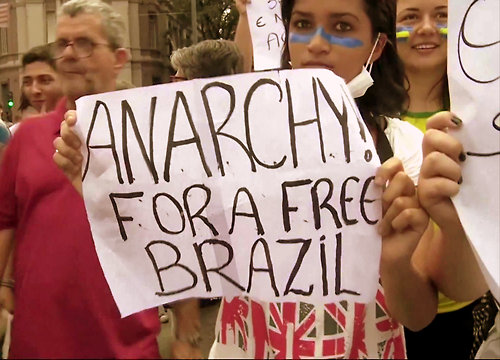
Solidarity with the Gaucho Anarchist Federation and the People of Brazil

Robert Graham's avatarRobert Graham's Anarchism Weblog

brazil free

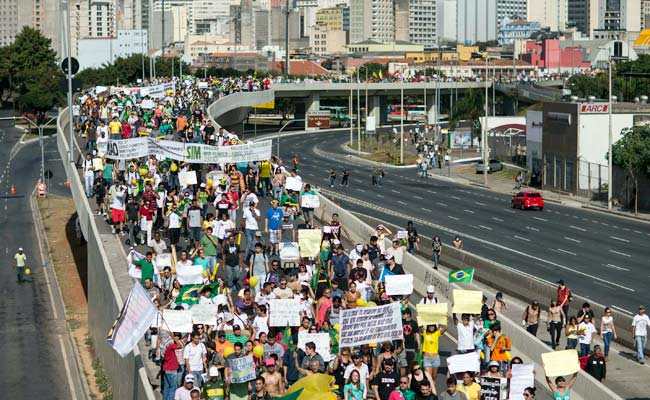
As mass protests against neo-liberal policies continue in Brazil, the authorities are now trying to pin the blame for the unrest on the Gaucho Anarchist Federation (FAG), raiding its office on June 2o, 2013. Below, I reproduce an international statement of solidarity with the FAG. In Volume Three of Anarchism: A Documentary History of Libertarian Ideas, I included excerpts from the FAG’s statement of principles, which advocates a form of “especifismo,” namely that the task for anarchists today is to participate in and be part of popular struggles against capitalism and authority. The massive protests in Brazil, and the many years of work of Brazilian anarchists within broad based social movements for change, illustrate how fruitful such a strategy can be.

Brazilian Protests Continue Brazilian Protests Continue

Solidarity Against the Persecution of the Federação Anarquista Gaúcha in Brazil

In Porto Alegre, on June 20 last, about 15 officers from the…

View original post 422 more words

Posted in Uncategorized | Leave a comment

117 Countries Slam American Police Brutality at UN Human Rights Council

http://countercurrentnews.com/2015/06/117-countries-slam-american-police-at-un-human-rights-council/

(ANTIMEDIA) In what could hardly be called a surprise, the UN Human Rights Council chastised the US over its epidemic of police violence, discrimination, needless killings, and general neglect, following through with recommendations made in its first review in 2010.

The Universal Periodic Review (UPR) takes place every four years to scrutinize the human and civil rights practices of each of the UN’s 193 member nations. Delegates from 117 countries took the opportunity to lambaste the US’ record of civil rights violations exacted by its brutal and racist police forces.

Posted in Uncategorized | Leave a comment

Video and a Brief Explainer from the Mexico City Uprising

bayareaintifada's avatarbayareaintifada

Correction: The text says Flores Magon’s newspaper was Metamorphis. Actually, it was Regeneración. Sorry about that. You can read the Regeneración newsletter here in Spanish or English. See a photo of one of the newsletter’s layouts, down below.

Mexico City

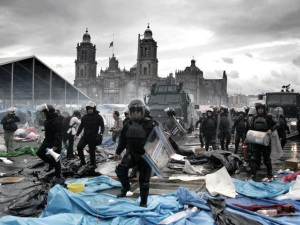
Riot police stomp on Mexico City's El Zocalo in front of a cathedral. Both the cathedral and the concrete sit on top of the sacred ruins of the Mexica Temples. Riot police stomp on the teacher’s encampment in Mexico City’s El Zocalo during the September 13 eviction. Both the cathedral and the concrete sit on top of the sacred ruins of the Mexica Temples.

For a couple of weeks now, mass mobilizations have been taking place in Mexico City against the privatization of education and energy. The Coordinadora Nacional de Trabajadores de la Educación–National Commission of Education Workers (CNTE) were joined by a large anarchist contingent and several clashes with police took place. In the next couple of days, a video was sent to Bay Area Intifada, but we didn’t want to post riots without context.

A…

View original post 2,449 more words

Posted in Uncategorized | Leave a comment